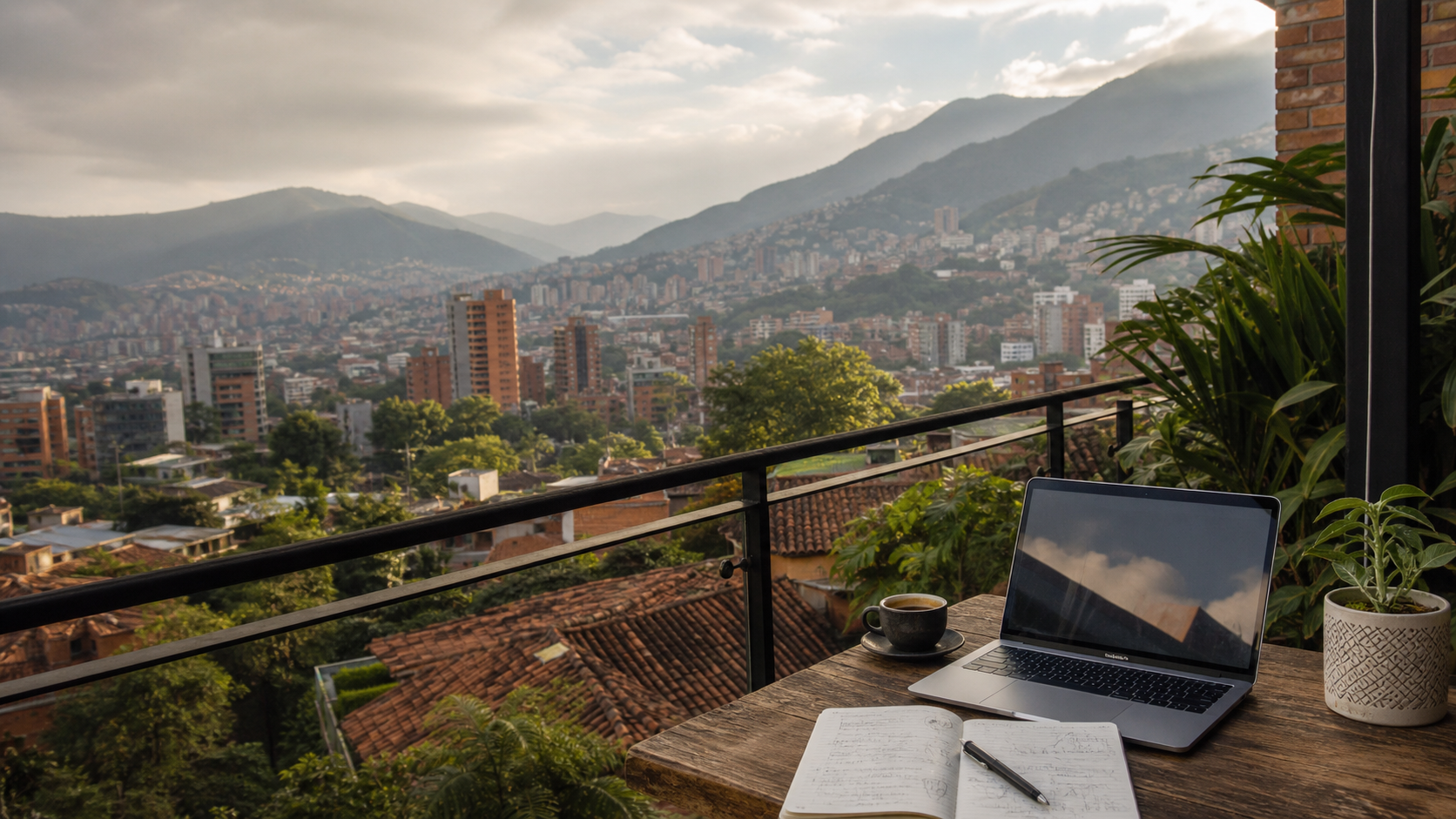
A clear Medellin neighborhood guide for remote workers comparing Laureles, El Poblado, Manila, Envigado, Belen, transport, housing tradeoffs, and everyday safety.
Published: August 1, 2026
Scope: practical planning, not personal legal or tax advice
Medellin is often presented as one city with one nomad neighborhood. In practice, choosing between Laureles, El Poblado, Manila, Envigado, and Belen changes the entire shape of your stay. It changes how flat your morning walk is, how long it takes to reach the Metro, how tourist-oriented your restaurants feel, what kind of apartment you can find, and how comfortable you are coming home after dark. Pick the wrong area and Medellin can feel like a sequence of rides. Pick the right one and the city becomes unusually easy to live in.
- Best first month
- Laureles for a flatter, neighborhood-scale daily routine
- Best for coworking and social density
- El Poblado, especially Manila and Provenza edges
- Best quieter alternative
- Envigado, if you accept a longer ride to the center
- Best value experiment
- Belen or La America after checking the exact block
- Transport anchor
- Use the Metro and integrated routes to reduce daily ride costs
No Medellin neighborhood is a guarantee of safety. Conditions change block by block, and the habits that make a stay safer matter more than a label such as 'expat area.' Choose a well-reviewed building, keep evenings simple while you learn the city, use known transport, and avoid treating nightlife or dating-app access as a travel safety strategy.
The decision in one minute
Choose Laureles if you want to walk to food, coffee, parks, gyms, and ordinary neighborhood errands without living inside Medellin's most international nightlife corridor. Choose El Poblado if you want the widest selection of furnished apartments, coworking, English-friendly services, and social events, and you are comfortable paying more for a hillier, busier base. Choose Envigado if you want a more residential rhythm and do not mind being farther south. Choose Belen or La America only after a short test stay, because their value depends heavily on the exact street and your commute.
For most first-time digital nomads, Laureles is the strongest default. It is not the most dramatic neighborhood, and that is precisely the point. The daily loop is manageable: apartment, bakery, lunch, gym, coworking, and a park can all be close together. El Poblado is more immediately stimulating, but some people discover after two weeks that they are paying a tourist premium to live beside nightlife they rarely use.
Laureles: the best all-round base
Laureles is the neighborhood to start with when you want Medellin to feel like a place where people live rather than a visitor district. The streets around Primer and Segundo Parque, Avenida Nutibara, and the tree-lined residential grid have restaurants, bakeries, cafes, supermarkets, gyms, and a steady local rhythm. The terrain is noticeably friendlier for walking than the steepest parts of El Poblado, although Medellin is still a valley city with heat, traffic, and uneven sidewalks.
Laureles works especially well for people with a predictable workday. You can set up in a cafe for lighter work, use a coworking space for calls, and return home without crossing the city. The tradeoff is that the area can feel quieter and less immediately social than El Poblado. You may need to make an effort to find events, Spanish practice, and international community instead of assuming they will appear at the next bar.
The Metro's integrated system includes routes and stops serving Laureles, including the Line O bus corridor, which gives the neighborhood better city access than its relaxed feel suggests. Verify the current route and station combination from your exact apartment rather than relying on a map distance. A five-minute walk to a bus route in a good direction is often more useful than a twenty-minute walk to the train.
Laureles is for you if...
- You want a walkable workweek with cafes, groceries, and restaurants close to home.
- You prefer residential streets to nightlife at your front door.
- You want a good first month before deciding whether Medellin is a longer-term base.
- You are happy to use rides or the Metro for occasional El Poblado events.
El Poblado: convenience, coworking, and more friction
El Poblado is the obvious nomad base because it has the strongest concentration of furnished apartments, international restaurants, coworking, gyms, cafes, and nightlife. Provenza and the blocks around Parque Lleras are the most visible part of that ecosystem, but they are not the only part. Manila tends to feel more manageable for a longer stay, while the south side around La Frontera and Aguacatala can be more residential and practical if you want mall services and a quieter apartment.
The hill is the hidden cost. A listing that looks close to a coworking space may be a steep walk in tropical heat, and a building near nightlife can be noisy long after your working day ends. Ask for a video showing the street approach, the apartment's window orientation, and the walk to groceries. Check whether the building has a backup water plan, reliable elevator access, and a desk that is actually usable for eight hours.
El Poblado is also where the difference between tourist comfort and local integration is most obvious. You can operate in English for much of the week, but doing so makes the city smaller. Learn enough Spanish for a pharmacy, a repair person, a taxi explanation, and a neighbor conversation. The best version of El Poblado is a base for exploring Medellin, not a self-contained international resort.
Manila, Provenza, or further south?
- Manila: a strong compromise for cafes, restaurants, and a calmer residential feel than the loudest nightlife blocks.
- Provenza and Parque Lleras: convenient for social life, but inspect noise, street activity, and the late-night walk before signing a month.
- La Frontera and Aguacatala: more practical for supermarkets, malls, gyms, and south-side access; less atmospheric for a first-time visitor.
Envigado: the quieter south-side option
Envigado is a separate municipality within the metropolitan area, and it appeals to nomads who want a more residential pace without leaving the Medellin orbit. It has its own central streets, restaurants, parks, and a local Colombian feel that can be easier to settle into than the international bubble around Provenza. The Metro connection through the southern corridor is useful, but your exact location still matters because some of the nicer residential areas are uphill or require a short ride.
This is a good choice for a second month when you already know your preferred coworking space, gym, and transport pattern. It is less ideal for a short visit if your goal is to attend events across Laureles, El Poblado, and the center every week. You may save on rent while adding time and ride costs. Measure the total routine, not just the listing price.
Belen and La America: value with a homework requirement
Belen and La America can offer a more local, less polished base with better space for the money. They are worth considering if you work from home, speak some Spanish, and can inspect the exact apartment and street in person. The value disappears if the building is far from a reliable grocery store, the desk is poor, or every meeting requires crossing the city. These neighborhoods reward a slow arrival; they are not a shortcut to a cheap version of El Poblado.
A useful test is to visit the building on a weekday morning, late afternoon, and after dinner. Listen for traffic, school, bars, and construction. Walk the route to your likely food and transport stops. If the area feels comfortable only when viewed from a car, keep looking. You do not need a neighborhood to feel luxurious, but you do need to understand the ordinary walk you will repeat dozens of times.
Coworking and the daily geography of work
MedellinCoworking in El Poblado is a useful reference point for the kind of workspace available in the city. Its official site lists fiber internet, coffee, air conditioning, events, hourly payment, a 7am to 7pm schedule, parking, and a location in Mall La Frontera. The point is not that one venue solves the whole city. It is that coworking in Medellin is often bundled with practical services such as supermarkets, restaurants, gyms, and transport, which makes the building's location part of the product.
If you live in Laureles, choose a Laureles workspace or accept that coworking becomes a twice-weekly destination rather than a daily office. If you live in Envigado, a southern workspace may be more valuable than the famous venue everyone recommends online. A good neighborhood guide should always end in a commute decision: where will you take your calls, and how often will you cross the valley to do it?
A realistic first-month budget framework
Medellin's price range is wide enough that a single monthly number misleads. A simple furnished apartment in Laureles or a less central part of Belen can be dramatically cheaper than a short-term high-floor apartment in Provenza. Add electricity, internet, cleaning, coworking, ride-hailing, eating out, and the tourist premium on weekends. If you are comparing neighborhoods, price two complete weekly routines rather than comparing two rent screenshots.
- Lean local routine: smaller apartment, neighborhood meals, home internet, occasional coworking, and public transport.
- Balanced nomad routine: reliable furnished apartment, coworking several days per week, regular cafes, gym, and rides at night.
- Premium Poblado routine: newer apartment, frequent restaurants and events, more ride-hailing, and a workspace chosen for convenience.
The largest budget mistake is usually short-term housing, not coffee. A host who charges a tourist rate for a building with poor soundproofing can cost more in lost work than a better apartment in a less fashionable block. Book a short test stay, inspect the room, then negotiate a longer arrangement once you know the neighborhood works.
Safety without the false promise of a safe neighborhood
Medellin deserves more honest guidance than either extreme of the internet: it is not a city where you should walk everywhere without thinking, and it is not a place that can be reduced to a warning label. The city government launched a 2026-2030 tourism security plan focused on informal services, travel-related risks, and coordination between tourism, security, and public authorities. That is useful context, but it does not replace your own habits.
- Use the first few evenings to learn the route from your building to food and transport while it is still light.
- Keep your phone away when walking between stops; step inside a business if you need to check a map.
- Use a reputable ride-hailing or pre-arranged service at night rather than flagging an unknown car.
- Do not advertise your apartment, income, or travel pattern to new acquaintances.
- Take official travel advice seriously and keep emergency contacts, insurance details, and a copy of your passport accessible.
The four-day neighborhood test
Before committing to a month, test one neighborhood with a normal work schedule. Day one is an arrival and grocery day. Day two is a full workday with your real calls. Day three is a morning walk, gym or park visit, and evening meal. Day four is a cross-city trip using the Metro or integrated bus system. Write down travel time, noise, heat, cost, and how often you felt you needed a car. That answer is more useful than a ranking list.
Official sources and related Nomad Terminal guides
Apartment prices, building security, neighborhood construction, and venue hours change quickly. Verify the exact address and walk it at the times you will actually use it before signing a long lease.
Make the next decision with the same context
Move from inspiration to the legal stay, city budget and risk checks that determine whether the plan works.