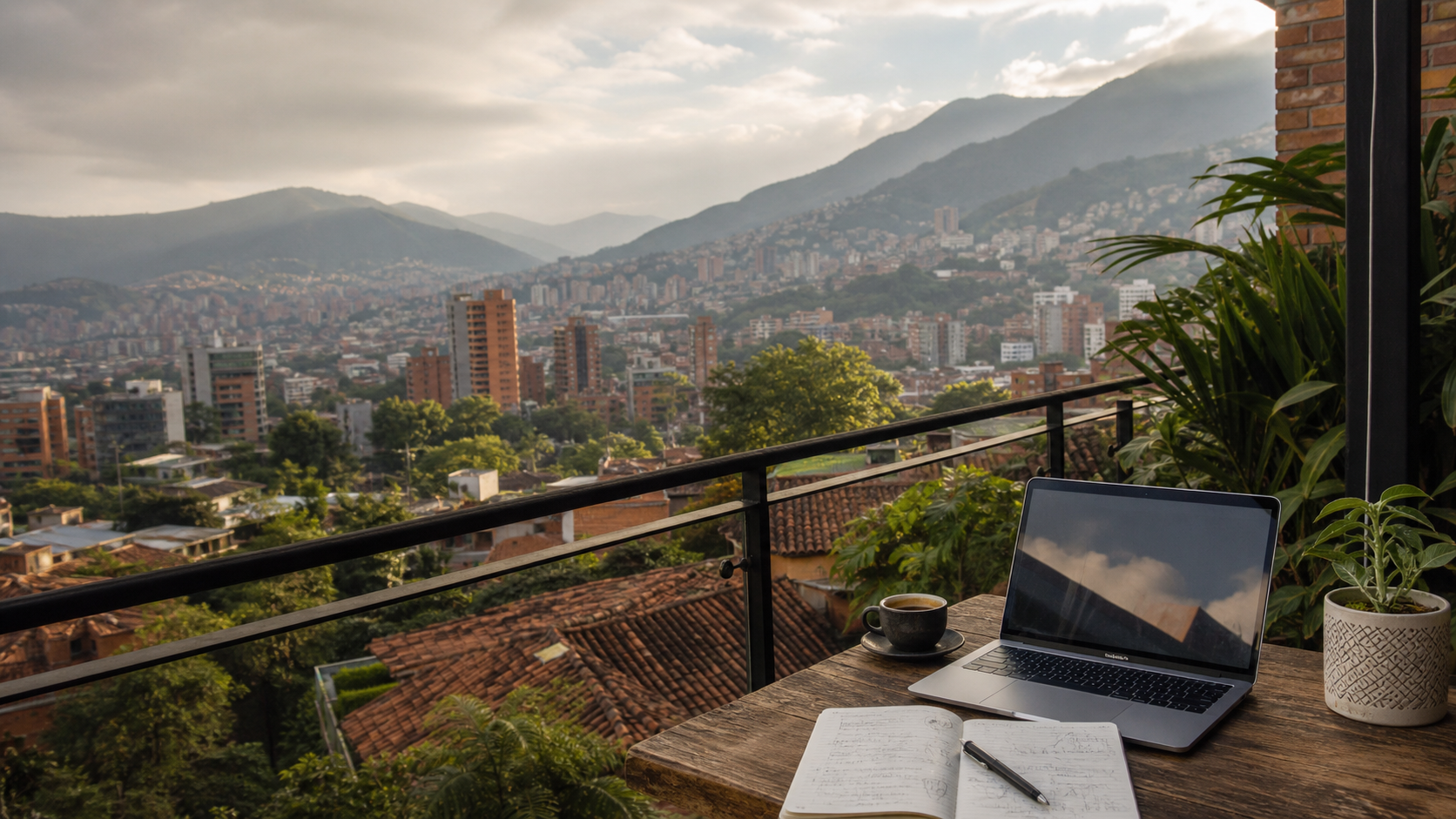
A clear-eyed Medellín safety guide covering dating apps, transport, ATMs, housing, street routines, emergency response and who should skip the city.
Published: August 13, 2026
Scope: practical planning, not personal legal or tax advice
Medellín can be an excellent remote-work base, but it is not a city where a comfortable apartment in El Poblado removes the need for a security routine. Violent robbery, drug-assisted theft, dating-app targeting and express kidnapping are documented risks in Colombia's major cities. The United States placed Colombia at Level 3, Reconsider Travel, in its March 31, 2026 advisory. That countrywide level does not mean Medellín is forbidden or that every visitor will experience crime. It does mean the correct starting point is deliberate risk management, not social-media reassurance.
This guide is built for a remote worker carrying a laptop, phone, bank access and weeks of accommodation, not for a weekend itinerary. It explains how to choose a building, move around the city, handle dates and nightlife, protect accounts, respond to an incident and decide whether Medellín fits your personal risk tolerance. No neighborhood is guaranteed safe. The useful question is whether your habits, housing and backup plan reduce your exposure enough for the city to remain worth choosing.
- Official emergency number
- 123 for police, medical and other emergencies in Medellín and across Colombia
- Current US advisory
- Level 3, Reconsider Travel, issued March 31, 2026 for Colombia
- Highest-value precautions
- Prebook transport, limit visible valuables, use indoor ATMs and keep first dates public
- Housing priority
- A staffed building with controlled access, a clear visitor policy and a low-profile route home
- Nomad Terminal baseline
- About $1,200 per month before insurance, safer transport and an emergency reserve
If someone threatens you during a robbery, do not resist to protect a phone or wallet. Official travel advice warns that street crime can become violent quickly. Your security setup should make devices and accounts recoverable so surrendering property does not become a financial catastrophe.
Is Medellín safe for digital nomads in 2026?
There is no responsible yes-or-no answer for every traveler. Medellín is a large working city where many residents and visitors live ordinary lives, while serious crimes against visitors also occur. Risk changes with time, location, behavior, visibility and simple chance. A person working by day, using arranged transport at night and living in a controlled-access building has a different exposure pattern from someone carrying a flagship phone between bars and bringing new acquaintances home.
Government advisories provide a floor for the decision. The current US advisory cites violent crime, drugging, kidnapping and armed break-ins among Colombia's risks. The UK government specifically warns of pickpocketing, mugging and armed robbery in major cities including Medellín. It also describes drug-assisted robbery, express kidnapping and criminals using dating apps to identify foreign visitors. These are not reasons to sensationalize the city. They are reasons to reject the idea that a popular nomad district is a protected bubble.
Medellín's own government is not ignoring the issue. The city launched a 2026 to 2030 District Tourism Safety Plan to coordinate prevention, inspection and visitor protection. That is constructive, but a policy launch is not a personal guarantee. Check your own government's current Colombia advisory before booking because nationality-specific assistance, insurance exclusions and regional warnings can differ.
Choose a building before choosing a neighborhood label
El Poblado, Laureles and Envigado are common starting points for foreign remote workers, but none should be described simply as safe. El Poblado offers the greatest concentration of short-term rentals, restaurants and international services. It also concentrates visible visitors, nightlife and people carrying expensive devices. Laureles often feels more residential and walkable, but ordinary street theft remains possible. Envigado can feel calmer and more local, although distance from meetings and nightlife can create more transport exposure.
The building is the more actionable decision. Prefer a staffed entrance with controlled access, functioning cameras in common areas, a lock that cannot be bypassed from a shared balcony and a written visitor process. Ask whether the front desk records visitors, calls the resident before entry and requires identification. Confirm whether short-term guests are allowed at all. A strict policy may feel inconvenient, but it removes improvisation when someone you barely know asks to come upstairs.
- Book three to seven flexible nights first, then inspect the building and street at both daytime and after dark.
- Walk the route to groceries, coworking and your likely transport pickup point without displaying your phone.
- Ask the host exactly how visitor access works and whether front-desk staff are present overnight.
- Test the apartment door, balcony access, bedroom safe and lobby intercom before unpacking valuables.
- Check whether ride pickups can happen inside a controlled driveway or directly at a staffed entrance.
- Avoid ground-floor rooms with easy street access and isolated hillside properties that require long walks after dark.
- Read the neighborhood guide, then judge the exact block instead of treating a district name as a security rating.
Build a low-visibility street routine
A remote worker's most exposed objects are also the tools needed to navigate: a phone, laptop and payment cards. Reduce the number of moments when those objects are visible. Memorize the first part of a route indoors, step into a shop if you need to check directions, and avoid standing at a curb with an unlocked phone. Use inexpensive earbuds only where situational awareness remains intact. Leave the premium watch and jewelry at home.
Do not turn this into performative paranoia. The goal is a boring routine that does not advertise value. Carry only the laptop you need that day. Use a plain bag with working zippers, keep it between your feet in restaurants and avoid hanging it over a chair. Choose a coworking space close enough that you are not repeating long laptop commutes. If a street becomes empty, poorly lit or uncomfortable, change direction before debating whether your feeling is rational.
Keep a small daily wallet separate from your passport, backup card and emergency cash. A decoy wallet is only useful if it is easy to hand over and does not tempt you to argue. Never risk physical harm to preserve the contents.
Use transport that preserves control
Prebook airport transport or use an established airport taxi process at José María Córdova International Airport. Confirm the driver and vehicle before entering. Share the trip with a trusted contact when possible and do not let an unexpected driver change become a casual handoff. The airport sits outside the city, so an arrival problem can be harder to correct than a short urban ride.
For city trips, the UK government advises using licensed telephone or internet-based taxi services and says not to hail taxis from the street. A hotel, restaurant or staffed coworking desk can also arrange a vehicle. Match the plate, car and driver information before opening the door. Sit in the rear, keep the route visible without waving the phone near an open window and end the ride in a lit, active place if the building entrance feels exposed.
The Metro is useful and heavily used, but crowded systems create pickpocketing opportunities. Keep bags closed and in front, move the phone away before doors open and avoid carrying your full work kit during unnecessary peak-hour trips. A motorbike can reduce travel time but increases road-injury exposure and leaves belongings visible. Security is not just crime avoidance. It includes choosing transport that you can use competently and insure properly.
Dating apps and drug-assisted robbery require a separate protocol
Dating-app crime deserves direct language because generic advice like be careful is inadequate. The US State Department says criminals use dating apps to attract victims and that US citizens in Colombia have been drugged, robbed and killed by people posing as dates. The UK government also warns that criminals use apps to identify solo foreign visitors. This risk is relevant to every gender and orientation, even if individual crime patterns differ.
- Have a short video call before meeting and look for inconsistencies in name, location and social history.
- Meet in a busy public venue that you choose. Do not begin at your apartment, hotel room or the other person's home.
- Send a trusted contact the profile, photo, venue and expected check-in time. Agree on a simple alert phrase.
- Arrange your own transport in both directions and keep the home address private until trust exists beyond one meeting.
- Watch drinks being prepared where possible, keep them with you and refuse open food, cigarettes or drinks from strangers.
- Do not accept a sudden venue change to a private or isolated location. Leaving is cheaper than resolving uncertainty later.
- If you feel unexpectedly confused, extremely drowsy or physically unwell, alert venue staff, contact your trusted person and seek medical help immediately.
Scopolamine is often discussed online as if it has mystical powers. Avoid folklore and focus on the documented outcome: incapacitation can facilitate robbery or assault. The UK advice says substances may be administered through food, drinks, cigarettes, aerosols or paper flyers and that high doses can be fatal. Do not test whether symptoms will pass alone. Call 123, seek urgent medical attention and tell clinicians that drugging is suspected.
Use ATMs and cards to limit financial damage
Express kidnapping can involve forcing a victim to withdraw money from one or more ATMs. Use machines during business hours inside a bank, supermarket or shopping center, which aligns with UK government advice. Avoid isolated street ATMs and do not count cash at the machine. If anything looks altered around the card slot or keypad, leave. Withdraw enough for ordinary small expenses without carrying a large balance.
The more important control sits before the withdrawal. Travel with a spending card that has a deliberately low balance or limit, while keeping a second card locked away. Disable cash advances on cards that do not need them. Turn on transaction alerts without revealing full message previews on the lock screen. Know how to freeze each card from another device and keep bank support numbers in an offline note.
Protect the phone as an account gateway. Use a strong device passcode rather than a simple pattern, require authentication for password-manager access and remove sensitive email or banking content from lock-screen notifications. Record the device identifier, enable remote location and wipe functions, and ensure a trusted person can help suspend the mobile number. A stolen phone should be a replaceable object, not the key to every financial account.
Secure the apartment and your work identity
Do not publish your building, balcony view, unit number or daily work location in real time. A beautiful check-in post can reveal where the entrance sits and that expensive equipment is inside. Delay location-specific posts until after departure, crop key cards and building names out of photos, and keep client calls from revealing an address on screen. Ask delivery drivers to meet at reception instead of sharing an apartment number whenever the building permits it.
Use full-disk encryption, automatic screen locking and tested cloud backups. Separate client files from local personal storage and keep recovery codes outside the device. A small cable lock is not a substitute for secure storage, but it can discourage opportunistic removal in a shared workspace. Never leave a laptop visible in a car, even for a quick stop. Confirm that business insurance or equipment cover applies in Colombia and understand exclusions for unattended property.
What to do if something happens
During an armed robbery, prioritize survival and avoid sudden resistance. Once safe, move to a staffed public place and call 123. Medellín's Integrated Emergency and Security System operates the city's 123 line around the clock and coordinates multiple response agencies. If drugging or injury is possible, request medical assistance promptly. Evidence matters, but collecting it should never delay urgent care.
- Call 123 and state your location, what happened, whether anyone is injured and whether the threat is still present.
- Contact the bank and freeze affected cards and accounts. Preserve transaction records and take screenshots from a safe device.
- Suspend the phone number, change the primary email password and use remote lock or wipe tools if the device is gone.
- Report the incident to police and obtain whatever reference or report the insurer requires. Procedures may differ from home.
- Contact your embassy or consulate if a passport is lost, if you need victim assistance or if the incident is serious.
- Notify the accommodation and coworking operator so access credentials, keys or building permissions can be changed.
- Use your insurer's assistance line before non-emergency treatment when the policy requires preauthorization, but never delay emergency care.
Keep the emergency information available offline in Spanish and English. Include your accommodation address, insurance number, allergies, emergency contact and embassy details. A color copy of the passport identity page can help while the original stays secured, although authorities may still require original identification in some situations. Review the procedure during daylight on the first day rather than learning it under pressure.
A realistic Medellín safety budget
Nomad Terminal's Medellín baseline is about $1,200 per month: $550 for accommodation, $300 for food, $110 for coworking, $50 for local transport, $15 for mobile data and $175 for other spending. A security-conscious budget may need more for a staffed building, arranged late-night transport, appropriate insurance and a separate emergency reserve. Do not force these costs into the entertainment category and then stop using them after one expensive week.
The cheapest apartment can create longer walks, less reliable access control and more late transport. The cheapest coworking choice can create repeated laptop trips. Optimize the whole route: home, work, groceries, exercise and evening transport. A compact routine can be both safer and cheaper than living far uphill and paying for multiple rides every day.
Who should choose another city
Choose another base if the precautions would make you anxious every day, if nightlife and spontaneous private socializing are central to the trip, or if you are unwilling to limit visible phone use and late solo walking. Medellín is also a poor first stop for someone who has never managed devices, banking and transport abroad and plans to learn all three after arrival. A city can be attractive and still be the wrong fit for your current risk tolerance.
If you remain interested, make the first booking short and reversible. Use the first 48 hours to test the building, transport, work route and how the security routine feels in practice. Read the Medellín neighborhood guide before selecting an area, confirm your Colombia stay permission and insurance, and leave enough flexibility to move. The strongest decision is not proving that a city is safe. It is knowing exactly what would make you stay or leave.
Official sources and useful next reads
- US State Department: Colombia travel advisory
- UK government: Colombia safety and security
- UK government: emergency help in Colombia
- Medellín: Integrated Emergency and Security System
- Medellín: 2026 to 2030 tourism safety plan
- Medellín destination hub
- Where to stay in Medellín
- Colombia digital nomad visa guide
- Digital nomad safety abroad
- Digital nomad insurance comparison
Research note: this guide was checked on August 13, 2026 against current US, UK and Medellín government sources. Conditions and advisories can change quickly. Review your own government's advice before travel. This is practical travel information, not a guarantee of safety or legal advice.
Make the next decision with the same context
Move from inspiration to the legal stay, city budget and risk checks that determine whether the plan works.


