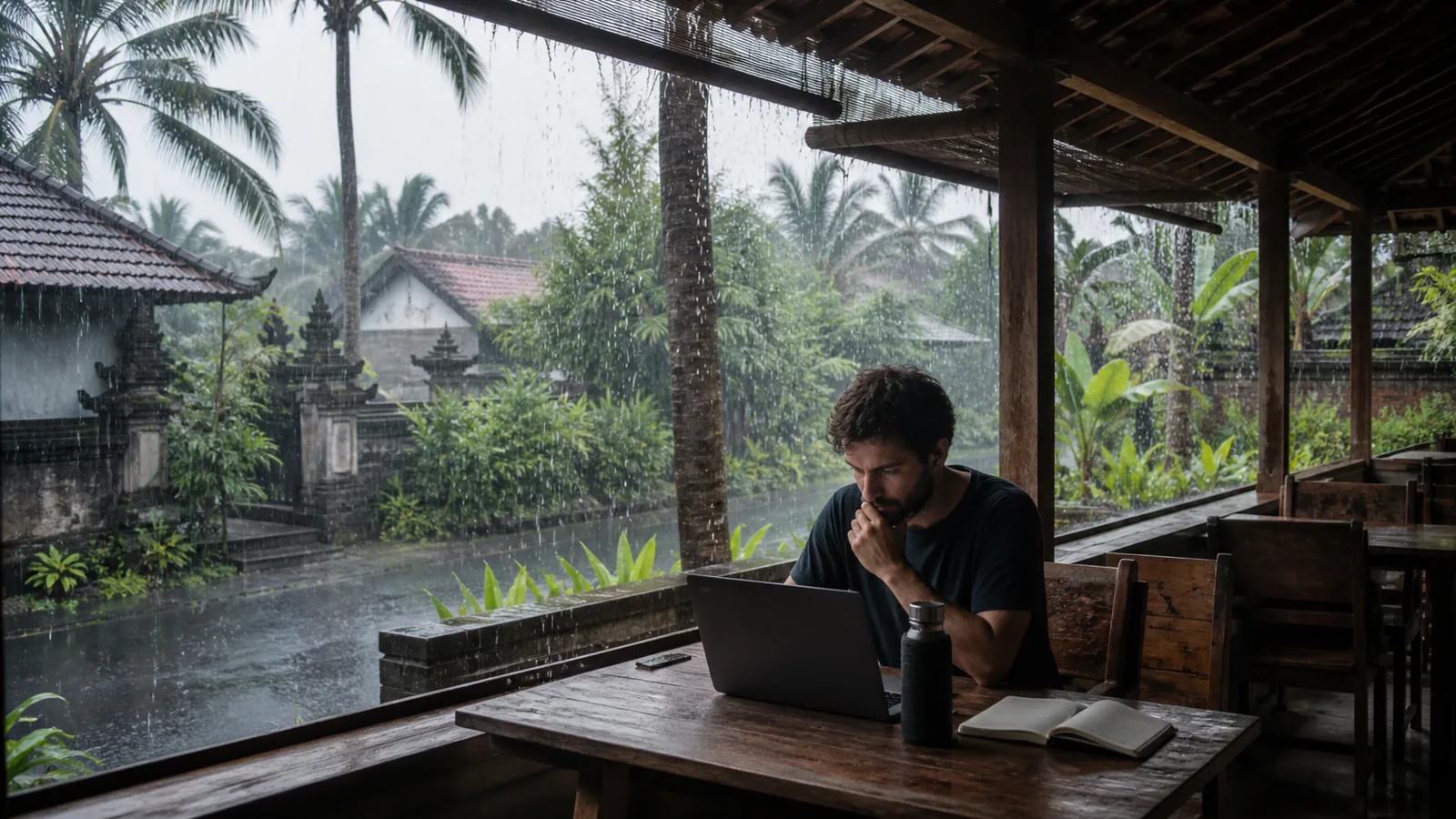
A field guide to working from Canggu during Bali's rainy season, with month-by-month planning, housing and flood checks, mold control, dengue prevention and a storm-proof work routine.
Published: August 13, 2026
Scope: practical planning, not personal legal or tax advice
Bali's rainy season is neither a guaranteed washout nor the harmless daily shower described in hotel copy. Many days still contain usable dry hours. The problem is that the difficult days are operationally different: a short route can flood, a scooter trip becomes unsafe, humidity finds the back of a wardrobe, mobile delivery slows down and a power or internet interruption arrives in the middle of a call. Canggu remains workable, but only if your home, desk and transport plan are built for rain.
This guide uses Bali's official BMKG seasonal material, Indonesian health guidance, WHO dengue advice and moisture-control standards, checked on August 13, 2026. The most recent complete Bali wet-season forecast available during research was for 2025-2026, when BMKG expected the island's seasonal peak mainly in January and February. That is a useful planning pattern, not a forecast for every future week. Check the live BMKG warning before making route decisions.
- Typical planning window
- Wet-season conditions usually build from roughly November and ease around March or April, with year-to-year variation
- Recent official peak pattern
- BMKG forecast the 2025-2026 Bali peak mainly for January and February
- Best wet-season setup
- Paved housing, visible drainage and a coworking desk within the same small neighborhood
- Indoor humidity target
- Keep relative humidity below 60 percent when possible and act quickly on leaks or condensation
- Health risk people underestimate
- Dengue mosquitoes are active during the day, not only at night
- Weather source to use
- BMKG and the official InfoBMKG app for local warnings, not a generic seasonal promise
Do not ride through water when you cannot see the road surface or current. A familiar lane can hide potholes, open drains and debris after intense rain. Wait, reroute or use a car. Being late is cheaper than a scooter accident or a water-damaged laptop.
What Bali rainy season actually means in Canggu
A seasonal average cannot tell you whether Tuesday afternoon will be dry. Tropical rain can arrive as a short intense cell, a long night of steady water or a broader multi-day event. The amount and timing vary across Bali because elevation, coast and local weather interact. Canggu sits in southern Badung, so use the district-level forecast and current radar rather than an island-wide icon.
BMKG's 2025-2026 Bali bulletin forecast normal seasonal rainfall for most of the province and above-normal rainfall in five seasonal zones. It expected the peak in January for nine zones and February for eleven. Badung appeared across the January peak areas, with part of central Badung also in the above-normal category. The correct lesson is not that every January day rains. It is that January and February deserve the strongest housing, health and transport margin.
The same bulletin noted that wet-season onset was earlier than the long-term average in eight of Bali's twenty seasonal zones and later in six. That spread is why fixed internet statements such as 'rain starts on November 1' are misleading. Plan with a seasonal window, then switch to the local forecast when your trip is close.
Month-by-month planning, not a weather promise
- October
- Transition risk begins to rise; inspect drainage and roof condition even if most of the stay still feels dry
- November
- More frequent storms become plausible; establish the backup desk and dry transport route early
- December
- Humidity and holiday demand overlap; book proven housing instead of relying on a last-minute bargain
- January
- Treat as a peak-risk month for heavy rain, transport delay, damp and mosquitoes
- February
- Keep the same peak-season operating margin; a sunny morning does not cancel an afternoon warning
- March
- Conditions may begin easing, but strong events and standing water remain possible
- April
- Transition toward drier conditions is common, though onset and finish can shift by year
Those labels are a planning framework based on the regional seasonal pattern, not daily climatology for one lane in Canggu. El Niño, La Niña, monsoon flow and short-lived atmospheric disturbances can move intensity and timing. Before signing a villa for a future season, look for BMKG's newest Bali bulletin. Before leaving for the day, use the active warning and radar.
Should a digital nomad visit Canggu in rainy season?
Yes, if your priority is a working base, you can tolerate schedule changes and you choose infrastructure over a rice-field view. Rainy season can offer a greener landscape and periods of lower demand outside holiday weeks. You may still get bright mornings and productive days. The trade is less control over movement and more work maintaining a dry, healthy room.
It is a poor match if your income depends on daily travel between distant venues, you are uncomfortable waiting out storms, your accommodation budget only covers low-lying rooms with uncertain drainage, or respiratory conditions make visible mold a serious concern. It is also not the ideal season for a first-time scooter rider. The wet surface, reduced visibility and unpredictable road edge add difficulty to an already demanding traffic environment.
- Good fit
- Slow stay, flexible calendar, walkable work base, strong housing inspection and reliable insurance
- Bad fit
- Daily cross-town commitments, fragile equipment, tight transfer days and no budget for a dry backup
- Best decision rule
- If the apartment, desk and essential food are reachable without crossing a known problem route, the season becomes much easier
Choose a micro-location, not just Canggu
Canggu is a collection of fast-growing villages and corridors. Batu Bolong, Berawa, Pererenan and the inland lanes can behave differently in the same storm. A rental pin near your favorite cafe says nothing about the last two hundred meters of access. During a viewing, walk the route from the main road to the door and look at the road surface, drainage channel, low points and places where runoff has nowhere to go.
- Prefer a fully paved approach from a larger road rather than a narrow dirt lane that turns to mud.
- Look for functioning drains with a visible downhill path, not a shallow channel blocked by leaves and construction material.
- Ask neighbors or staff where water reached during the most recent severe storm. A precise answer is more useful than 'never floods.'
- Check whether the entrance, bedroom and electrical outlets sit above the exterior ground level.
- Map two routes to the coworking space and identify the lowest intersections on each.
- Keep groceries, pharmacy and laundry within the same small operating zone.
A ten-minute dry-season scooter trip is not a ten-minute rainy-season guarantee. Build the base around the route you can safely walk or cover by car when the shortest lane is unusable.
The rainy-season housing inspection
View after recent rain when possible. A dry-season viewing hides roof leaks, drain capacity, wall seepage and how the room smells after being closed. Turn off fragrance diffusers and air conditioning for a few minutes, then inspect slowly. The goal is not a perfect tropical room. It is a room with controllable moisture and a clear repair response.
- Inspect the ceiling, wall-to-roof junctions, window frames and air-conditioning pipe penetrations for stains or soft paint.
- Open wardrobes and drawers. Smell stored linens and the back corners, where stagnant air reveals damp first.
- Check the mattress underside, bed base, curtains and upholstered furniture for spots or a musty smell.
- Run every air conditioner and confirm it has a dry or dehumidification mode, a clean filter and a drain that flows outside.
- Ask whether a portable dehumidifier is supplied and who pays for electricity during continuous moisture control.
- Inspect bathroom extraction, shower drainage and any open-air bathroom exposure to rain.
- Look at exterior roof overhangs and whether wind-driven rain reaches doors, workspace or covered scooter parking.
- Ask for the outage history, water-pump setup, generator or battery backup and the person to contact after hours.
- Test Wi-Fi and mobile signal from the exact desk with doors and windows in their normal storm position.
- Write the moisture and leak remedies into the rental agreement instead of accepting a verbal promise to fix them later.
Mold control for a tropical work room
Mold control begins with moisture control. The US Environmental Protection Agency recommends keeping indoor relative humidity below 60 percent when possible and drying wet materials within 24 to 48 hours. That target can be difficult in open tropical architecture, which is exactly why the room needs functioning air conditioning, drainage, air movement and a way to measure humidity rather than guess.
- Use a simple digital hygrometer near the desk and another near the wardrobe if the room repeatedly smells damp.
- Run the air conditioner's dry mode or a dehumidifier with doors and windows closed when outdoor air is saturated.
- Do not push luggage, paper boxes or clothing tightly against an exterior wall.
- Dry wet shoes and rain gear in a ventilated utility area, not inside the sleeping room.
- Report leaks immediately and photograph the source, wet material and repair response.
- Clean and dry small hard-surface spots only if you can also stop the moisture source. Larger or recurring growth needs professional remediation or a different room.
A heavily perfumed room, recently repainted patch or permanently running air conditioner deserves a closer look. None proves a mold problem, but each can mask the conditions you need to assess. People with asthma, allergies or immune concerns should discuss travel and housing risk with a clinician and leave accommodation that is causing symptoms.
Build a storm-proof workday
The most reliable rainy-season routine moves important work into the most controllable part of the day. Check BMKG after waking. If the morning is stable, travel early with equipment protected. Complete calls and uploads from a fixed desk before the highest-risk afternoon window. When a warning or intense cell arrives, stay put instead of racing it home.
- Choose one primary coworking space within a short paved route and buy enough access that you do not debate every storm.
- Save an offline map, the coworking phone number, accommodation contact and insurance assistance number.
- Put the laptop, charger, power bank and passport in separate waterproof sleeves inside a closed backpack.
- Carry a compact umbrella for walking and a proper rain layer for waiting or transfers. A thin poncho is not protective storage for electronics.
- Sync critical files before the forecast deteriorates and keep the day's essential documents available offline.
- Use mobile data from a different network path than the fixed broadband when possible.
- Leave slack before every call that follows a journey. Rain turns a tight itinerary into a missed meeting quickly.
Canggu already has multiple dedicated workspaces. Use the separate coworking guide on this site to compare current access products, then revisit the route through a wet-season lens. The best-looking space is not the best backup if the only approach regularly holds water or if its covered areas become noisy during a storm.
Power and internet redundancy
A brief power interruption can take the router down even when your laptop battery is full. Ask whether the coworking space keeps network equipment on a UPS and whether the accommodation has backup power for the router or water pump. Carry a charged power bank that can run your phone and, if supported, your laptop. Test the backup before a real deadline.
- Primary connection
- Fixed broadband tested from the exact desk during the hours you work
- Second path
- Local mobile data with usable indoor signal and enough tethering allowance
- Power layer
- Charged laptop, phone power bank and coworking network equipment protected by backup power
- File layer
- Offline copies of the day's essential work plus cloud sync before storms
- Location layer
- A confirmed coworking fallback that does not share the apartment's router or electrical circuit
Scooters, cars and flooded lanes
The practical transport rule is simple: if visibility collapses, water hides the surface or lightning is close, stop in a safe covered place. Do not shelter under a tree. Do not follow another scooter into water as proof that your route is safe. Engine intake height, potholes and rider experience differ, and the water can deepen between vehicles.
A car booked through a reputable app can reduce exposure but does not remove flooded-road risk or guarantee pickup during a peak event. Build time into the day and accept that some deliveries or rides will be canceled. If you rent a scooter, confirm the license, international permit, helmet and insurance requirements for your nationality and policy. Many travel policies exclude unlicensed or non-compliant riding.
CDC guidance for Indonesia also advises travelers to avoid swimming or wading in water that may be contaminated with animal urine and to protect cuts near floodwater. Floodwater is not a shortcut. If water reaches the route on foot, turn around, keep cuts covered and wash exposed skin safely after contact. Seek medical advice if you become unwell after exposure.
Dengue prevention belongs in the daytime routine
Indonesia's Health Ministry warns that standing water during the rainy season creates mosquito-breeding opportunities. Its 3M Plus program focuses on draining and scrubbing water containers, covering stored water and removing or recycling objects that collect rain. In a rental, inspect plant saucers, open buckets, roof gutters and decorative water containers around the room or terrace, then ask staff who empties them.
WHO emphasizes that the Aedes mosquitoes that spread dengue are active during the day. Use repellent containing DEET, picaridin or IR3535 as directed, wear covering clothing when practical, and prefer screened or air-conditioned rooms. A mosquito coil at night does not cover the morning and late-afternoon periods when exposure can occur.
High fever, severe headache, pain behind the eyes, body aches, nausea or rash after possible exposure need medical assessment. WHO advises avoiding ibuprofen and aspirin when dengue is suspected because of bleeding risk and using paracetamol for pain while seeking appropriate care. Severe abdominal pain, persistent vomiting, bleeding, rapid breathing, marked weakness or restlessness require urgent care.
Rainy-season equipment that earns its space
- Two roll-top or zip-seal waterproof sleeves, one for the laptop and one for documents and small electronics.
- A backpack rain cover used as an outer layer, not the only waterproof barrier.
- Compact umbrella, breathable rain jacket and sandals or shoes with reliable wet grip.
- Digital hygrometer for the bedroom or office.
- Power bank, short charging cable and a small dry pouch for adapters.
- Mosquito repellent with a proven active ingredient and a refill plan.
- Basic medical kit, insurance details and the location of an appropriate clinic.
- Microfiber cloth and a dry bag for wet rain gear so it stays away from electronics.
Do not carry the entire office every day. Leave nonessential drives, spare chargers and paperwork in a dry secure room. The lighter the bag, the easier it is to protect and the less tempted you are to balance it awkwardly while moving through rain.
A rainy-season arrival checklist
- Install InfoBMKG and save the Bali early-warning page before arrival.
- Book the first week in accommodation with credible paved access and recent rainy-season reviews.
- Inspect long-stay housing after rain before paying the full term.
- Test the route to a primary coworking space and one alternative.
- Buy local mobile data before relying on villa Wi-Fi.
- Locate the nearest suitable clinic and save its number offline.
- Photograph your insurance certificate, policy wording and assistance contact.
- Establish a no-ride threshold for water depth, visibility and lightning before pressure makes the decision for you.
A practical rainy-day schedule
- 06:30
- Check BMKG, radar, active warnings and the local road group before committing to travel
- 08:00
- Move to the primary desk while conditions are stable, with equipment already waterproofed
- 09:00-14:00
- Place calls, large uploads and deadline work inside the most controlled block
- 14:00 onward
- Recheck conditions before every move; wait out intense cells rather than racing them
- Evening
- Dry rain gear outside the bedroom, recharge every device and inspect the room for new moisture
The exact hours vary, and rain can arrive at any time. The value of the schedule is the sequence: forecast, move early, complete critical work, reassess, dry and recharge. Repeating that system removes much of the decision fatigue that makes a wet season feel chaotic.
When to leave the room or change accommodation
Move immediately if water reaches electrical equipment, the ceiling visibly sags, a wall outlet gets wet, sewage backs up or staff cannot isolate a serious leak. Do not sleep under an active ceiling leak or continue using wet electrical circuits. For chronic moisture, recurring visible mold, persistent respiratory symptoms or repeated access flooding, document the problem and request a safe room or exit under the agreement.
A host who responds quickly to one exceptional leak can still be responsible. A host who repeatedly paints over staining, blames every moisture problem on the guest or asks you to use unsafe electrics is giving you operational evidence. Protect your health and work continuity before protecting the booking.
Our verdict on Canggu in the rainy season
Canggu can be a productive rainy-season base when you shrink the geography of daily life. Choose a dry room with controllable humidity, a paved route, a dedicated desk nearby, local mobile data and enough schedule slack to stop moving when the weather turns. That setup converts rain from a daily emergency into a condition you manage.
If the budget forces you into a low-lying room reached by an unpaved lane, with no moisture control and a long scooter commute, choose a different neighborhood or season. The rainy-season discount is not real savings if it costs workdays, equipment, health or unsafe travel.
Official weather, health and housing sources
Build the rest of your Canggu setup
Weather and health conditions change. This guide is based on sources available on August 13, 2026. Follow current BMKG warnings and obtain medical advice for personal health decisions.
Make the next decision with the same context
Move from inspiration to the legal stay, city budget and risk checks that determine whether the plan works.


