Renting in Dubai is not difficult because apartments are scarce. It is difficult because the quoted annual rent is only one part of the cash requirement, portal asking prices are not the same as signed contract data, and a polished listing can make an unverified payment request feel normal. A nomad needs a process that works before the viewing, at the contract table and again when the deposit should be returned.
This guide is for remote professionals choosing between a licensed short stay and a conventional annual tenancy. It uses Dubai Land Department, Rental Disputes Center and DEWA information checked on August 19, 2026. It is practical research, not individualized legal advice. For a dispute or unusual ownership structure, use the official channels and a qualified Dubai professional rather than a forum answer.
- First decision
- Short licensed stay for flexibility, or a one-year Ejari tenancy for stability and control
- Price anchor
- Check the DLD Smart Rental Index and signed transaction evidence, not only portal asking prices
- Ejari fee
- AED 177.75 online through Dubai REST or AED 220 through a trustee center on the current DLD page
- DEWA move-in
- AED 2,000 refundable apartment deposit plus AED 155 supply activation fee on the current service page
- Housing fee
- Tenant pays a municipality tax equal to 5 percent of annual rent through the electricity bill, according to DLD FAQ
- Research date
- Official rules, service fees and market snapshots checked August 19, 2026
Choose the correct rental lane first
A licensed monthly or short stay
Choose a serviced apartment, hotel apartment or properly operated holiday home when your dates are uncertain, you are still testing neighborhoods or you cannot absorb annual-lease setup. The nightly or monthly price is higher, but furniture, utilities, internet and flexible checkout may be included. That premium buys a smaller commitment and less administration.
Ask for the full licensed business name, invoice, unit address, cancellation rule, tourism charges, utility cap and deposit terms. Do not accept an informal ‘monthly’ sublet simply because it is furnished. Confirm that the person offering the unit has authority to do so and that the building permits the use. A cheap unofficial stay can fail exactly when you need address evidence, maintenance or a deposit refund.
A conventional annual Ejari tenancy
Choose an annual tenancy when you know the city, have stable residency plans and want a home you control. Dubai Land Department’s current Ejari campaign page lists a minimum Ejari period of one year. Registration creates the official tenancy record used for services such as DEWA and gives both parties a documented contract trail. It also brings larger upfront cash needs and a contract that cannot simply be abandoned when travel plans change.
The upfront cash stack most listings hide
Build a cash schedule before attending viewings. The rent is commonly paid using one or more cheques, and the number and due dates are negotiated with the landlord. On top of those cheques, you may face a landlord security deposit, brokerage commission, Ejari fee, DEWA deposit and activation, moving costs, internet setup and immediate furnishing. Only some of these amounts are government-fixed.
- Rent cheques
- Negotiated amount and schedule; write every due date and payee into the signed contract
- Landlord deposit
- Negotiated security against damage; 5 percent unfurnished and 10 percent furnished are common conventions, not universal statutory rates
- Broker commission
- Agreed in advance; 5 percent is common market practice, not a single government-fixed residential fee
- Ejari
- AED 177.75 online or AED 220 at a real estate services trustee center on DLD’s current service page
- DEWA
- AED 2,000 refundable flat deposit plus AED 155 activation for a typical small residential meter
- Municipality housing fee
- 5 percent of annual rent, collected through the electricity bill according to DLD guidance
Suppose the annual rent is AED 96,000 and the landlord accepts four equal cheques. The first cheque is AED 24,000. If the agreed deposit and commission are each 5 percent, those add AED 4,800 plus AED 4,800. Add AED 177.75 online Ejari, AED 2,000 refundable DEWA deposit and AED 155 activation, and the immediate stack reaches AED 35,932.75 before moving, internet or furniture. This is an illustration, not a mandatory fee quote for every tenancy.
The housing fee in that example is AED 4,800 for the year, typically collected across DEWA bills rather than as one signing payment. Chiller or district-cooling deposits and consumption may be separate from DEWA. Ask for the exact cooling provider and previous summer bills because ‘AC included’ can mean several different things.
Current one-bedroom price signals by neighborhood
The following Bayut snapshots were checked on August 19, 2026. Each combines a portal’s current average asking rent with the DLD transaction average shown on the same area page. They are useful directional evidence, not a valuation for a specific tower, view, furnishing level or floor. The official Smart Rental Index and comparable registered units should carry more weight in a renewal or negotiation.
- Dubai Marina
- 1BR asking average AED 106,461; DLD transaction average AED 100,780
- Jumeirah Lake Towers
- 1BR asking average AED 94,237; DLD transaction average AED 89,672
- Business Bay
- 1BR asking average AED 105,612; DLD transaction average AED 98,969
- Jumeirah Village Circle
- 1BR asking average AED 79,894; DLD transaction average AED 74,956
- Al Barsha 1
- 1BR asking average AED 73,121; DLD transaction average AED 70,345
Which Dubai neighborhood works for remote life?
Jumeirah Lake Towers: best balance for many nomads
JLT combines Red Line access, walkable clusters, groceries, cafes and easy movement to Marina without paying for the waterfront label. It is one of the most practical areas for a remote worker who wants daily needs close and occasional office travel along Sheikh Zayed Road. Tower quality varies sharply, so inspect lifts, cooling, noise and lobby traffic rather than buying the cluster name.
Dubai Marina: lifestyle and transit, with congestion tradeoffs
Marina offers a recognizable waterfront, abundant furnished stock, the Metro and Tram, and easy social infrastructure. It also brings tourist turnover, evening congestion and meaningful building-to-building variation. A nominal five-minute walk to transit can be uncomfortable in summer or blocked by road layout. Test the route and the lift queue at commuting time.
Business Bay: central for meetings, inconsistent on foot
Business Bay can shorten travel to Downtown, DIFC and central meetings, but not every tower is realistically close to the Metro or a useful grocery. Construction, road crossings and taxi access matter at building level. It suits a client-facing nomad who values centrality, provided the exact tower removes rather than adds daily friction.
JVC: more space for the price, more dependence on roads
JVC often offers newer apartments and a lower one-bedroom average, but most routines rely on taxi, car or bus connections. The rent saving can disappear into transport, delivery and time if your meetings and friends are on the Metro corridor. It works well for home-focused work and drivers; it is weaker for a visitor expecting a rail-based city.
Al Barsha 1: practical rather than theatrical
Al Barsha 1 provides groceries, services, Mall of the Emirates access and more conventional residential value than Dubai’s postcard districts. Older buildings can have larger layouts, but maintenance quality deserves scrutiny. It is a strong choice for someone who values function, Red Line access and a realistic annual budget over a branded view.
Verify the broker, owner and unit before paying
Dubai Land Department says a broker must hold a real estate brokerage licence, be registered in the brokers registry and have a RERA broker card. Use the DLD e-card verification service in Dubai REST to check the card number and current practitioner information. Match the broker, brokerage and communication channel; a copied card image proves little by itself.
DLD’s title-deed verification service can validate the property and, where selected, owner and property data. Ask for the official title information and compare the owner’s identity with the contract and payment beneficiary. If a representative signs, inspect the relevant power of attorney. Do not send rent or deposit to an unrelated personal account based only on a messaging-app explanation.
- Verify the broker’s RERA e-card in Dubai REST.
- Verify the title deed and owner through the DLD service.
- Confirm the exact unit number, parking space and included storage at the physical viewing.
- Match the contract landlord or authorized representative to the verified ownership trail.
- Confirm the legal payee for each cheque, deposit and commission in writing.
- Request a receipt that identifies the unit, purpose, amount, date and recipient.
- Register Ejari through the official workflow, not a screenshot supplied as the only evidence.
The apartment inspection remote workers need
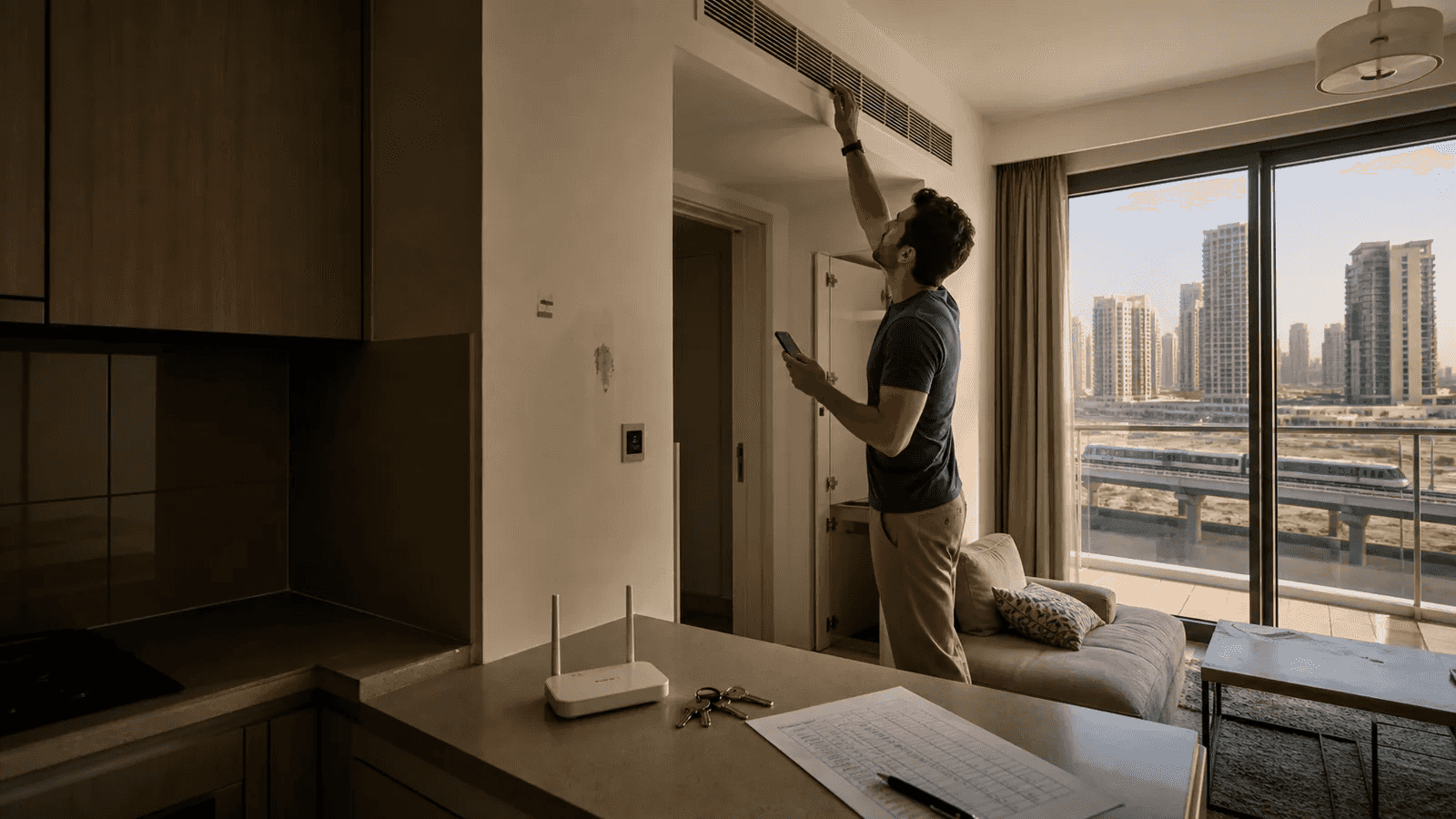
Inspect during daylight, then return near the hour you will work or sleep. A remote worker spends more time in the unit than a commuter, so cooling noise, construction, mobile signal and desk ergonomics have higher value. Photograph every room, defect, appliance serial number and meter with permission. The signed inventory should match what remains in the apartment on handover day.
Cooling and utilities
- Run the air conditioning in every room and listen for fan, compressor and vent noise at the intended desk.
- Ask whether cooling is billed by DEWA, a district-cooling provider, the landlord or included in rent.
- Request recent summer bills for the exact unit when available, not an estimate for the building.
- Check water pressure, hot water, drainage, leaks below sinks and signs of moisture around vents.
- Identify every utility deposit, activation fee, minimum charge and final-bill process.
Internet and calls
- Ask which fixed providers and packages are actually available to the unit and whether an old account must be cleared.
- Check the fiber or router point before choosing the desk location.
- Test mobile data from your intended work area, bedroom and balcony as an independent fallback.
- Close windows and make a test call to expose road, aircraft, pool, lift and neighboring-unit noise.
- Confirm that the building allows your installation visit and that you can access the telecom room if required.
Building operations
- Ride the lifts at peak time and ask how maintenance outages are handled.
- Inspect parking dimensions and access rather than relying on ‘one space’ in the listing.
- Ask about move permits, loading times, refundable building deposits and service-lift booking.
- Check gym, pool and common-area access against the contract. DLD guidance says tenants are entitled to use included building facilities for the rent paid.
- Read recent building notices for maintenance, facade works, pest treatment or amenity closures.
Clauses to settle before signing
The unified tenancy contract is only the base. An addendum can record additional terms when all parties sign it. Read both as one agreement and eliminate contradictions. If an agent says a side promise is standard, put it into the signed text. Messages are useful evidence, but a clear contract is better than reconstructing intent during a dispute.
- Exact parties, unit, parking, storage, furnishing inventory and permitted use.
- Annual rent, number of cheques, due dates, payee and consequence of a failed payment.
- Security-deposit amount, holder, permitted deductions, evidence standard and refund deadline.
- Early-termination procedure, notice, penalty and whether a replacement tenant changes it.
- Maintenance responsibility, emergency contacts and any minor-repair threshold.
- Chiller or cooling responsibility, utility accounts and what ‘included’ actually covers.
- Internet, pets, guests, painting, cleaning, alterations and move permit obligations.
- Handover condition, snagging period and signed inventory with dated photographs.
- Renewal communication addresses and the method for formal notices.
Ejari registration step by step
Ejari is the official registration of the tenancy. DLD’s current service page lists AED 177.75 through the Dubai REST app or website, made up of government and service-partner components, and AED 220 through a trustee center. The online path involves the tenancy data and landlord approval. At a trustee center, the current required documents include the original unified contract and original Emirates ID, with power-of-attorney documentation if a representative acts.
- Make sure the previous tenant’s Ejari is cancelled. DLD warns that an active old record can prevent the new tenant from registering.
- Sign the final unified tenancy contract and every addendum with matching dates and unit details.
- Use Dubai REST or the DLD website when eligible, or visit an authorized trustee center.
- Submit the required tenancy and identity information and pay the official channel fee.
- Follow the landlord approval request. DLD’s campaign page says an app request auto-cancels if the landlord does not approve within five days.
- Save the issued Ejari certificate and verify all names, dates, rent and unit details immediately.
- Use the Ejari-linked DEWA message to complete utility activation and retain every receipt.
DEWA move-in after Ejari
DEWA integrates its electricity and water move-in with Ejari. After the certificate is issued, DEWA receives the tenancy data and sends the new account number, deposit details and payment link. Its current page lists a refundable AED 2,000 deposit for a residential flat and AED 4,000 for a villa. The typical small-meter supply activation fee is currently shown as AED 155.
The service page targets activation within 15 working hours after the required deposit and fees are paid. Save the opening meter readings and confirm the old account’s final balance does not create a handover problem. Free-zone and owner scenarios can follow different channels, so use the path DEWA provides for the specific premise.
Rent renewal and the Smart Rental Index
Dubai’s current Smart Rental Index uses DLD and Ejari data at property or building level. DLD says a rent increase applies only when the index confirms eligibility and the landlord gave the required notice at least 90 days before contract expiry. The 90-day rule also applies when either party wants to amend other contract terms, unless both parties agreed otherwise.
Decree 43 of 2013 sets the maximum increase ladder. There is no increase when current rent is up to 10 percent below the comparable average; the maximum is 5 percent when 11 to 20 percent below, 10 percent when 21 to 30 percent below, 15 percent when 31 to 40 percent below and 20 percent when more than 40 percent below. Run the official index for the actual unit and renewal date rather than applying a portal average yourself.
Protecting the deposit at move-out
Dubai law allows a landlord to collect a security deposit for maintenance at the end of the tenancy and requires return of the deposit or remaining balance. The practical dispute is usually evidence. Build the exit file on day one: signed inventory, timestamped photographs, defect report, maintenance requests and written approvals. Repeat the photographs after cleaning and at key handover.
- Send non-renewal or other required notice through the contract’s formal method and within the agreed period.
- Ask for the move-out inspection date, cleaning standard and permitted deduction evidence in advance.
- Obtain DEWA and any cooling final bill using the proper move-out process.
- Photograph the unit, meters, keys, access cards and inventory at handover.
- Use a signed key-handover record with date, time and representative name.
- Request an itemized deposit statement and invoices for any proposed deductions.
- Keep Ejari cancellation and final-payment records after leaving the UAE.
Common Dubai rental mistakes
- Choosing a neighborhood from a skyline view without testing the summer walk and peak-hour road access.
- Budgeting only the first rent cheque and forgetting deposit, commission, Ejari, DEWA and moving costs.
- Treating 5 percent deposit or commission as a universal law instead of a negotiable contract term.
- Comparing a furnished short stay with an unfurnished annual rent before adding utilities and furniture.
- Paying an unverified personal account under artificial time pressure.
- Relying on a broker-card screenshot rather than the DLD e-card verification service.
- Accepting ‘chiller free’ without identifying which cooling costs remain and who pays them.
- Signing an early-exit clause that does not define notice, penalty and handover procedure.
- Failing to cancel the previous Ejari or document the new registration promptly.
- Taking move-in photos but no signed inventory or written defect acknowledgment.
A safer seven-day rental process
- Day 1
- Choose annual versus licensed short stay and set a full upfront-cash ceiling
- Day 2
- Shortlist buildings around work, transit and cooling, not only neighborhood names
- Day 3
- View representative units, test utilities and collect exact fee sheets
- Day 4
- Verify broker e-card, title deed, owner and payment recipient
- Day 5
- Compare Smart Rental Index and registered evidence; negotiate cheques and clauses
- Day 6
- Review the unified contract and addendum as one document; sign only the completed version
- Day 7
- Register Ejari, activate DEWA and complete a photographic handover inventory
Our Dubai rental verdict
A first-time Dubai nomad should usually buy flexibility before buying the lowest annual equivalent. Spend a short period testing the commute, summer walking route, building operations and neighborhood rhythm. When an annual tenancy becomes the right move, calculate the whole cash stack, verify every participant through DLD and make the addendum carry the promises that matter.
The strongest bargain is not the listing with the largest discount. It is the home whose ownership is clear, cooling and internet are understood, contract supports your travel pattern, Ejari registers cleanly and deposit evidence survives move-out. Dubai has excellent remote-work apartments, but the value is created by verification and contract detail, not tower branding.
How much cash do I need upfront to rent an apartment in Dubai?
Budget the first rent cheque plus the negotiated landlord deposit and broker commission, AED 177.75 online or AED 220 trustee-center Ejari, a refundable AED 2,000 DEWA flat deposit, AED 155 typical activation, and moving, internet, cooling or furnishing costs. The exact cheque schedule and private fees depend on the contract.
Is a 5 percent rental deposit mandatory in Dubai?
No single 5 percent rate applies to every residential tenancy. Five percent for an unfurnished unit and 10 percent for furnished are common market conventions. The agreed amount, permitted deductions and refund process should be written clearly into the contract.
What is Ejari and how much does it cost in Dubai?
Ejari is Dubai’s official tenancy registration. DLD currently lists AED 177.75 through Dubai REST or the website and AED 220 through a real estate services trustee center. Registration supports the official tenancy record and services such as DEWA activation.
How can I verify a Dubai rental broker and owner?
Use Dubai REST’s RERA e-card verification for the broker and DLD’s title-deed verification for the property and ownership data. Match those results to the contract and payment recipient, and inspect any power of attorney used by a representative.
Can a landlord raise Dubai rent at renewal?
Only when the official Smart Rental Index supports an increase and the notice requirements are met. DLD says a landlord must notify the tenant at least 90 days before expiry, unless agreed otherwise. Decree 43 sets maximum bands from zero to 20 percent based on how far current rent is below the comparable average.
Which Dubai area is best for digital nomads renting long term?
JLT offers a strong balance of Metro access and daily services. Marina suits waterfront lifestyle, Business Bay suits central meetings, JVC offers more space with greater road dependence, and Al Barsha 1 emphasizes practical value. The exact tower and route matter more than the district label.
Official Dubai rental services and rules
- DLD register or renew Ejari
- DLD current Ejari campaign and approval rules
- DLD Smart Rental Index
- DLD Smart Rental Index explanation
- DLD tenancy and rental FAQ
- DLD title-deed verification
- DLD RERA e-card verification
- Government of Dubai rent-increase decree
- Rental Disputes Center FAQ
- DEWA electricity and water move-in
Current neighborhood price snapshots
- Dubai Marina apartment rents
- JLT apartment rents
- Business Bay apartment rents
- JVC apartment rents
- Al Barsha 1 apartment rents
Build the rest of your Dubai setup