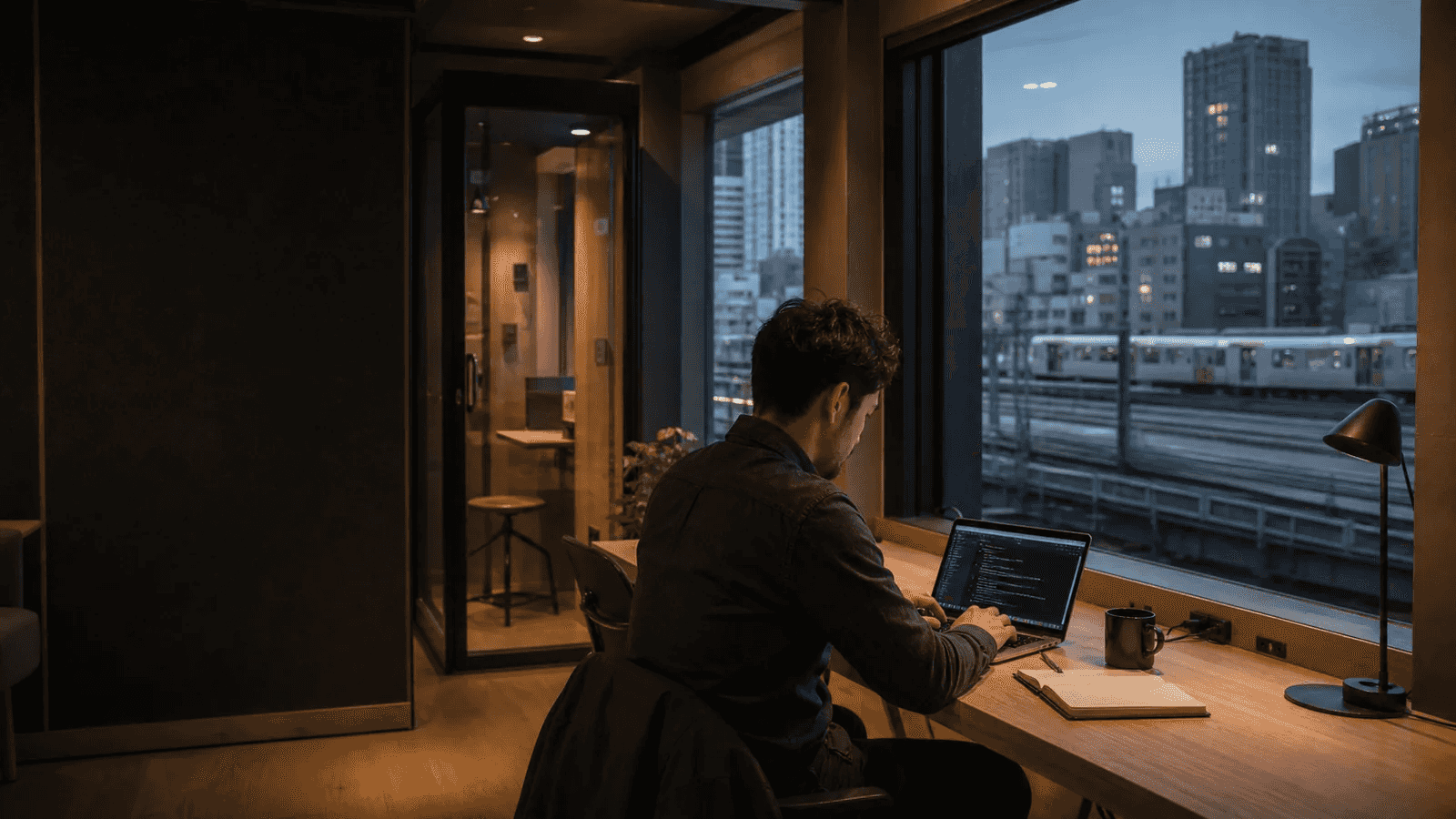
The best coworking space in Tokyo is not automatically the one with the most beautiful interior or the fastest train from Shibuya. It is the one whose access window, call policy and short-stay contract fit the work you actually need to finish. Tokyo has an enormous supply of offices, hotel lounges and pay-by-the-hour workspaces, but many search results blur together drop-in desks, members-only communities and cafes where a two-hour video call would be inconsiderate.
We checked current operator pages on August 19, 2026 and selected four options that publish enough detail for a nomad to make a real decision. Prices below include tax where the operator explicitly says so. Rules and availability can change, so confirm the product on the operator’s booking page before crossing the city. The goal is not a list of every desk in Tokyo. It is a dependable shortlist for one day, one week or one month of serious work.
- Best all-round short stay
- .andwork Shibuya for long daily access, reservable phone booths and a simple one-day to four-week ladder
- Best week or month value
- S-TOKYO in Nihonbashi for inexpensive short passes and 24-hour access after registration
- Best client-call day
- BLINK Roppongi for a professional setting with bookable booths and meeting rooms
- Best flexible city lounge
- SHARE LOUNGE for bookable branches near major stations, snacks and low-commitment use
- Typical verified day-pass range
- JPY 2,200 to JPY 3,300 among the dedicated spaces in this shortlist
- Research date
- Prices, hours and access rules checked August 19, 2026
The Tokyo coworking shortlist
- .andwork Shibuya
- JPY 3,300 day pass; 07:00-24:00 drop-in access; free reservable phone booths
- S-TOKYO
- JPY 3,300 day, JPY 11,000 week or JPY 27,500 month; Nomad Pass access is 24/7
- BLINK Roppongi
- JPY 2,200 full weekday or JPY 1,100 after 13:00; booth JPY 495 per 30 minutes
- SHARE LOUNGE Suidobashi
- JPY 1,320 per hour with a JPY 4,620 day maximum; 08:00-22:00
- SHARE LOUNGE Yaesu South
- JPY 1,760 per hour with a JPY 6,600 day maximum; 08:00-22:00 near Tokyo Station
These are not interchangeable products. A capped lounge rate can be excellent for two hours between trains and poor value for a full week. A 24-hour pass is useful only after you understand the first-registration window. A free booth is valuable only if it can be reserved when your call begins. Choose by work pattern first and neighborhood second.
1. .andwork Shibuya: best all-round short-stay workspace
.andwork occupies a central Shibuya location inside The Millennials hotel, around six minutes on foot from JR Shibuya Station. Its strongest feature is not the address. It is the unusually clear short-stay ladder: JPY 1,100 per hour, JPY 3,300 for a day, JPY 25,000 for ten visits, then JPY 14,000 for one week, JPY 27,000 for two, JPY 35,000 for three and JPY 43,000 for four weeks on the current operator page.
Normal drop-in access runs from 07:00 to midnight, while week plans advertise 24-hour access. The workspace includes Wi-Fi, power, drinks, a shared kitchen and reservable phone booths at no additional charge. An evening happy hour and hotel connection add social value, but this is still a work-first recommendation: a nomad can land, buy a day to test the room and move into a week product without signing a conventional office contract.
- Choose it for a one to four-week Tokyo sprint, especially if calls are part of most workdays.
- Test the exact area at your normal work time. A hotel-linked lounge can feel different in a busy evening than early morning.
- Reserve a booth before a high-stakes call even though booth use is included.
- Check which facilities remain available overnight on the week product and how re-entry works after staffed hours.
- Budget for Shibuya convenience rather than commuting from a cheaper desk across the city.
2. S-TOKYO: best-value Nomad Pass for a week or month
S-TOKYO is in Nihonbashi Kodenmacho, east of the Tokyo Station business core and close to Kodenmacho Station. Its public Nomad Pass pricing is the strongest value in this shortlist: JPY 3,300 for one day, JPY 11,000 for one week and JPY 27,500 for one month, tax included. The operator states that Nomad Pass holders can use the workspace 24 hours a day.
There is one operational trap: first registration must be completed on a weekday between 09:00 and 17:00. The site says registration and payment are not available on weekends or holidays. Arriving in Tokyo on Saturday night and planning a Sunday start will therefore fail unless the operator confirms another arrangement. Register while staff are present, test the door system and save the support contact before your first late session.
Phone-booth economics also vary by pass. The public service page gives one free booth hour per day to week and month users, but explicitly excludes the one-day pass from that allowance. Other user booth time is listed at JPY 800 per hour. A four-person meeting room is listed at JPY 2,200 per hour. That makes S-TOKYO exceptionally economical for focused solo work, but a one-day caller should price the room and booth separately.
- Choose it when your accommodation is east of central Tokyo or your clients sit near Tokyo, Nihonbashi or Akihabara.
- Register before 17:00 on a weekday, even if you intend to work only at night.
- Use the week or month product if daily private calls make the included booth hour valuable.
- Ask how busy booths are during Japan business hours and whether reservations are required.
- Bring headphones. A low-cost open workspace still depends on considerate shared-room behavior.
3. BLINK Roppongi: best professional drop-in for client work
BLINK is a community-oriented coworking space in Roppongi. Its weekday drop-in product is simple: JPY 2,200 for a full day between 09:00 and 18:00, or JPY 1,100 for a half day after 13:00. The current service page lists phone booths at JPY 495 per 30 minutes and meeting rooms from JPY 3,850 per hour. It also offers a short-term Boarding Pass, including some 24-hour access options, but does not publish a current price on the page we checked.
BLINK works best when the quality of the meeting environment matters more than the cheapest possible seat. Roppongi is convenient for international business, embassies and client lunches, and a properly booked booth is a better choice than trying to whisper through a confidential call in a lounge. The trade is a shorter standard drop-in window and additional call-room spend.
- Choose the half day for an afternoon block after a client meeting elsewhere in central Tokyo.
- Add booth or meeting-room time to the real day cost before comparing BLINK with an all-inclusive alternative.
- Ask for a current Boarding Pass quote if you need multiple days or after-hours access.
- Confirm that a specific room is available before sending a calendar invitation.
- Use a private room for sensitive work. A polished common area is still a shared room.
4. SHARE LOUNGE: best flexible workspace between neighborhoods
SHARE LOUNGE is a network rather than one coworking office. Branches combine reservable work seating with power, Wi-Fi, drinks and snacks. That makes the format useful when you need a controlled two-hour work block near a station without onboarding into a community membership. Normal hourly app payment receives a 10 percent discount according to the operator, although the discount does not apply to day maximums, monthly products or passes.
Branch choice materially changes the price. The work-focused Suidobashi WORKS branch lists JPY 1,320 per hour and a JPY 4,620 day maximum, open 08:00 to 22:00. It is unmanned, requires app use or reservation, and lists private booths from JPY 1,650 per hour. Yaesu South near Tokyo Station lists JPY 1,760 per hour and a JPY 6,600 day maximum, also open 08:00 to 22:00. A multi-location premium plan starts at JPY 41,800 per month on the network page.
This is the best option here for fragmented city days: a morning near a client, an afternoon train from Tokyo Station or a quiet stop between hotel check-out and an evening departure. It is not automatically the best full-day value. At the published maximum, Yaesu South costs twice the dedicated day pass at .andwork or S-TOKYO. You are paying for station convenience and low commitment.
- Install and register the official app before depending on an unmanned branch.
- Check the individual branch page, not the network homepage, for hours, seat types and same-day availability.
- Reserve a private booth for calls instead of assuming every seat permits conversation.
- Use the day maximum as a ceiling when comparing a lounge with a dedicated coworking pass.
- Treat snacks and drinks as convenience, not a reason to choose a poor commute.
A famous name that is not a short-stay recommendation
Impact Hub Tokyo appears frequently in coworking roundups, but its current English page says it does not accept drop-ins and requires a minimum three-month commitment. The public monthly prices are JPY 33,000 for basic access, JPY 47,300 for 24/7 access and JPY 55,000 for a fixed seat. It may be a strong community for a resident founder. It is not a practical answer to ‘where can I work tomorrow?’ and should not be presented as one.
Choose by workday, not by Instagram photo
- One focused day with calls
- .andwork if booths are available, or BLINK if a formal meeting environment matters
- One week on a budget
- S-TOKYO after weekday registration; .andwork if Shibuya and more included booth access are worth the premium
- Late-night schedule
- A verified 24-hour week product at S-TOKYO or .andwork, with re-entry tested before staff leave
- Two hours near a station
- The nearest SHARE LOUNGE branch with the seat and booth type you need
- Confidential client day
- BLINK with a reserved booth or meeting room, priced into the day
- Three months or longer
- Then compare community memberships and fixed seats, including Impact Hub, against your home neighborhood
The phone-call test most lists ignore
A workspace can be excellent for writing and unusable for a customer-success shift. Before paying for a week, list every call longer than fifteen minutes and ask four questions: Is speaking allowed at the desk? Is there a booth? Can it be reserved? What happens when the free allowance ends? A ‘phone booth available’ icon does not answer any of them.
- Book a single day and run one normal call before buying the longer product.
- Measure background noise through your meeting software, not just with your ears.
- Check booth ventilation, power and mobile signal before a ninety-minute interview.
- Confirm the maximum booking length and whether back-to-back reservations are allowed.
- Keep a second nearby call option for the one hour you cannot afford to improvise.
24-hour access is a system, not a line on a sales page
If Europe or North America determines your schedule, 24-hour access can remove a major Tokyo constraint. But the useful product includes more than an unlocked door. Confirm the first-registration deadline, re-entry method, overnight heating or cooling, restroom access, booth rules, security contact and whether cleaning temporarily closes part of the floor. Also map the last train and a safe walk home. A 24-hour desk does not make Tokyo’s rail network run all night.
For repeated late sessions, housing within walking distance can be worth more than saving a few thousand yen on the pass. Taxi spend and sleep disruption quickly erase a cheap workspace. Tokyo rewards small operating geography: home, desk, food and a useful train line inside one compact circuit.
A one-day Tokyo coworking inspection
- Time the door-to-desk journey during the hour you will normally travel, including the station exit and elevator wait.
- Run an upload and a video call from the exact seat zone you would use.
- Inspect chair adjustment, desk depth, glare, outlet position and monitor availability.
- Locate booths, then ask how reservations and overage charges work.
- Check food rules, kitchen access and whether calls are allowed during your overnight hours.
- Leave and re-enter once if access outside staffed hours matters.
- Calculate the full weekly cost, including booth time, transit, food and any meeting room.
Coworking etiquette in Tokyo
Read the room before speaking. Quiet shared areas are often genuinely quiet, and a laptop does not turn a cafe seat into a call booth. Keep headphones at a level that does not leak, take longer conversations into the designated room, clear the desk when the pass requires it and follow sorting rules for rubbish. If the space asks users to reserve a seat or scan in through an app, do it even when the room looks empty.
Japan’s hospitality can make an unworkable request sound politely possible. Ask specific operational questions instead of ‘Is it okay?’ Try: ‘Can I speak continuously in this seat from 20:00 to 21:00?’ or ‘Can a one-day user reserve this booth?’ Precise questions produce answers you can build a calendar around.
What a Tokyo workspace really costs
Compare cost per productive day, not the headline pass. A JPY 11,000 week pass used for five days is JPY 2,200 per workday before calls. A JPY 3,300 day pass with free booths can be cheaper than a JPY 2,200 entry plus several paid booth blocks. A station lounge can save an hour of travel on a split day. The rational answer changes with the calendar.
- Desk price
- Pass or hourly access, including consumption tax where confirmed
- Call price
- Phone booth and meeting-room time beyond any allowance
- Transit price
- Daily fares plus the work time lost crossing the city
- Schedule price
- Taxi or sleep cost when the last train conflicts with overseas calls
- Failure price
- The value of a missed call when a booth or registration rule was assumed
Our Tokyo coworking verdict
Start with .andwork Shibuya if you want the least complicated short-stay setup and regular private calls. Choose S-TOKYO when a week or month of 24-hour access matters more than a Shibuya address, but complete registration during the weekday window. Use BLINK for a polished client day in Roppongi, and use SHARE LOUNGE as a flexible station-based tool rather than forcing it into a full-time office role.
The winning move is a paid test day. Tokyo makes it easy to confuse proximity on a map with a workable routine. Sit in the room, run the call, leave after hours and calculate the complete week. That small experiment tells you more than another twenty-workspace roundup.
What is the best coworking space in Tokyo for digital nomads?
.andwork Shibuya is the best all-round short-stay choice in this comparison because it combines hourly, daily and one-to-four-week products with long access hours and free reservable phone booths. S-TOKYO is better value for a week or month if its location and registration window suit you.
How much is a coworking day pass in Tokyo?
The verified dedicated-space day passes in this shortlist cost JPY 2,200 at BLINK and JPY 3,300 at .andwork or S-TOKYO. Lounge pricing may be hourly with a higher day maximum, and private booths can cost extra.
Can I find 24-hour coworking in Tokyo?
Yes. S-TOKYO advertises 24/7 access with its Nomad Pass, and .andwork advertises 24-hour access on week plans. Confirm registration, re-entry, overnight facilities and support before depending on either for a late call.
Can I take video calls from a Tokyo coworking space?
Usually only in designated areas or phone booths. Policies and charges differ by product. Ask whether desk calls are allowed, whether booths can be reserved and how much time is included before scheduling a long meeting.
Do Tokyo coworking spaces require advance registration?
Some do. S-TOKYO requires first registration on a weekday between 09:00 and 17:00 and says registration and payment are unavailable on weekends and holidays. Unmanned SHARE LOUNGE branches may require app registration or reservation. Check before arrival.
Is a cafe or SHARE LOUNGE better than coworking in Tokyo?
A lounge is useful for a short, low-commitment work block near a station. Dedicated coworking is usually better for repeated full days, private calls and 24-hour access. Ordinary cafes should be treated as hospitality businesses, not assumed to permit long calls or an all-day office setup.
Official workspace sources
- .andwork Shibuya access and pricing
- S-TOKYO Nomad Pass services and prices
- S-TOKYO location and registration details
- BLINK Roppongi drop-in and room pricing
- SHARE LOUNGE network and membership
- SHARE LOUNGE Suidobashi WORKS
- SHARE LOUNGE Yaesu South opening and pricing
- Impact Hub Tokyo membership terms
Build the rest of your Tokyo setup