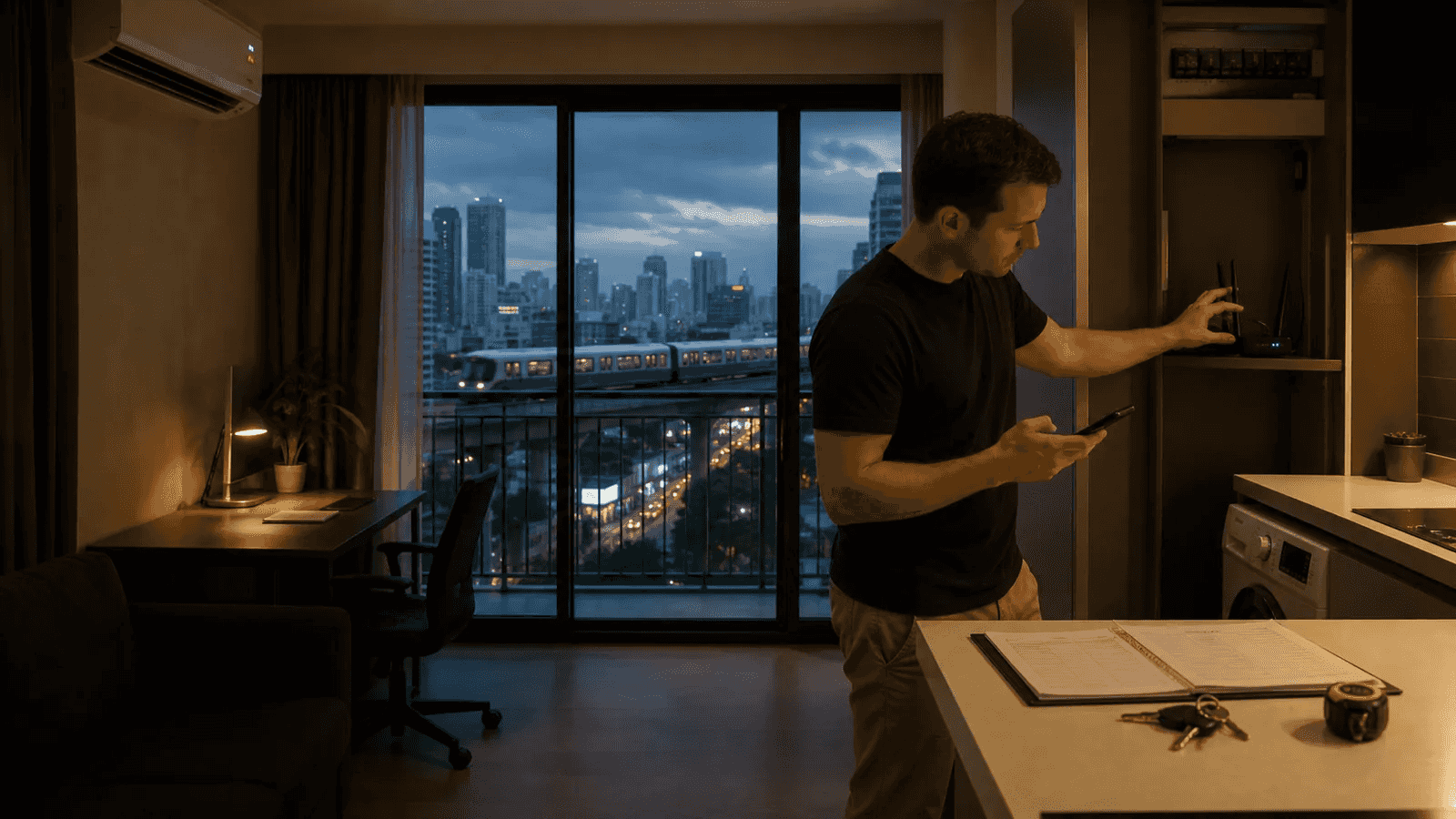
Renting in Bangkok becomes much easier when you stop searching for ‘an apartment’ and choose the correct product for your length of stay. A hotel room, serviced apartment, operator-run apartment and privately owned condominium may look nearly identical in photos. They do not have the same contract, management, utility billing, repair path or willingness to rent for three months.
This guide turns that difference into a decision system. It uses Thailand’s current consumer-protection material, the official TM30 reporting system, Bangkok listing data and current project asking prices checked on August 19, 2026. It is practical housing research, not legal advice. Thai contract scope depends on who operates the building and the facts of the lease, so use the official OCPB channel or a qualified Thai professional when a dispute matters.
- Under 30 days
- Use a licensed hotel or professionally operated serviced residence, not an anonymous nightly condo listing
- One to five months
- Managed apartment or serviced apartment is usually the lowest-friction product; some condo owners will negotiate
- Six to twelve months
- Private condos offer the widest inventory and better monthly economics, with more contract and deposit responsibility
- Deposit rule to understand
- For businesses covered by Thailand’s controlled residential-rental rules, advance rent plus security deposit cannot exceed three months’ rent
- Immigration document
- Ask before paying whether the landlord or property manager will file TM30 and give you evidence
- Research date
- Rules and asking-rent examples checked August 19, 2026
First choose the right Bangkok rental type
Hotel or serviced residence
This is the cleanest answer for a short arrival, uncertain visa timeline or demanding first month. Reception handles access, cleaning and reporting; utilities are usually packaged or clearly billed; and repairs have an on-site escalation path. You pay more per night or month, but you avoid furnishing gaps, private-owner delays and a long lease before you understand the commute.
Operator-run apartment
In Thai real-estate language, an apartment building is commonly controlled by one operator rather than a collection of individual unit owners. The operator can offer standardized rooms, one office for maintenance and sometimes one-month contracts. Electricity and water billing must be checked carefully. Covered rental businesses cannot charge water or electricity above the rate imposed by the service provider under the current OCPB controlled-contract framework.
Privately owned condominium
A condominium building contains individually owned units. Two apartments on the same floor can have different furniture, routers, landlords, contracts and repair standards. Six or twelve-month leases are common because owners want stable occupancy and agents need enough commission to justify the transaction. A condo often gives better residential facilities and more listing choice, but building management may refuse to solve an in-unit problem that belongs to the owner.
Match the contract to the stay
- 7-29 nights
- Licensed hotel or serviced apartment with a nightly product
- 1-2 months
- Monthly hotel, serviced residence or apartment advertising short monthly terms
- 3-5 months
- Managed apartment first; then negotiate selected condos with a clear premium or advance commitment
- 6 months
- Reasonable condo target, but inventory and negotiating power are weaker than at twelve months
- 12 months
- Largest private-condo pool and strongest headline monthly rent, with the greatest exit risk
Do not sign twelve months merely to open up a lower monthly figure if your immigration permission, client income or preferred neighborhood is uncertain. The relevant price is the cost of the time you will really use plus the cost of leaving. A flexible THB 30,000 month can be cheaper than a THB 24,000 lease that strands a two-month deposit when plans change.
For a first Bangkok stay, book seven to fourteen nights near the intended transit line and conduct viewings in person. Photos cannot reveal construction noise, evening traffic, water pressure, corridor odors, elevator queues or the last ten minutes of a commute in tropical rain.
What rent looks like in 2026
Bangkok does not have one useful average rent. Unit age, walking distance to rail, floor, view, owner, furnishing and contract term change the number too much. DDproperty showed roughly 57,700 Bangkok condominium rental listings when checked, but portals contain repeated inventory and asking prices rather than signed contract data. Use a project-level range to calibrate a neighborhood, then compare the exact room.
- D65, Phra Khanong/Ekkamai
- One-bedroom asking average around THB 24,000 from four active listings
- Waterford Diamond Tower, Sukhumvit
- One-bedroom asking average around THB 30,000 from 23 units; two-bedroom around THB 36,000 from 69
- Noble Around Sukhumvit 33
- One-bedroom asking average around THB 52,000 from 45 units
- The Diplomat Sathorn
- One-bedroom asking average around THB 37,000 and two-bedroom around THB 54,000, each from 36 units
- Short-monthly example
- RentHub showed central apartment inventory including roughly THB 14,000-36,000 monthly products
Those are current asking snapshots, not market valuations and not promises that a particular room remains available. Small samples can be distorted by one unusual listing. Their value is comparative: central new Sukhumvit inventory carries a different price from older stock east of Ekkamai, while Sathorn can work well for Silom-facing schedules. Save ten comparable units and inspect at least three before treating any asking price as normal.
Choose a rail station before a neighborhood name
Bangkok housing searches are often framed as Sukhumvit versus Sathorn versus Ari. For a worker, the station and walking route are more useful. A map pin 700 meters from the BTS can mean a pleasant shaded path, a highway crossing or an exposed twenty-minute walk once heat and signal waits are included. Test the journey at the time you will actually make it.
- Asok and Phrom Phong reduce friction for central meetings and abundant services, but newer one-bedrooms command a premium and traffic is intense.
- Thong Lo and Ekkamai offer dining, international services and polished condo stock, with wide variation between rail-adjacent towers and deep sois.
- Phra Khanong and On Nut usually provide more space for the same budget while keeping BTS access, but a daily trip west can become tiring.
- Ari has a calmer residential-cafe character and BTS access, though it is not automatically convenient for every Sukhumvit client.
- Sathorn and Silom suit work around the business district; compare BTS, MRT and BRT routes rather than relying on the district label.
- Rama 9 and Huai Khwang can offer modern MRT-linked inventory and value, but the commute to lower Sukhumvit is not the same as living on it.
Where to search without losing control of the process
Large portals such as DDproperty are useful for project-level inventory and price comparison. RentHub is useful for apartment buildings and short monthly products. Property agents can open up private condos quickly, while building juristic offices sometimes know of owner listings in the same tower. Facebook groups and marketplace posts can surface direct deals, but identity and authority require more verification, not less.
- Define maximum door-to-station minutes, contract length, all-in budget, desk requirement and move-in date before messaging anyone.
- Save listings by building, then remove duplicate photos and near-identical rooms before estimating the range.
- Ask whether the advertised room is currently available. Some ads are lead generators for a different unit.
- Request the exact unit number only at a safe stage, but insist on seeing the exact room before transferring the full deposit.
- Group viewings in one area so you can compare building management and street conditions on the same day.
- Write every promised repair, furniture item and fee into the agreement or signed handover record.
The remote-work viewing test
A generic speed-test screenshot is not proof that your desk works. It may come from another unit, a wired office or a quiet hour. Ask for router access, connect your own laptop and run download, upload, latency and a video call from the exact desk with the doors closed and air conditioner running. Repeat on mobile data because the concrete core and coated windows of a high-rise can weaken indoor signal.
- Confirm whether internet is included, which provider serves the unit and whose name is on the account.
- Photograph the router model, placement and cable termination. A router hidden in a metal cabinet can underperform a good line.
- Ask whether you can upgrade the package and how installation access is approved by the building.
- Test the bedroom and balcony-door zone if the main desk fails, but do not accept a bed as the only work surface.
- Check mobile tethering on a second network path for important calls.
- Ask about recent outages and whether building power loss also stops pumps, lifts or the fiber equipment room.
Inspect the physical desk with the same rigor: chair height, screen glare, outlet reach, air-conditioner draft and background visible on calls. A countertop and dining stool photographed as a ‘workspace’ can become expensive back pain by week two. Agree in writing if the owner will add a real chair or if you may replace furniture temporarily.
Room-by-room inspection checklist
- Run every air conditioner for at least ten minutes. Listen for vibration, smell the output and check for water leakage.
- Open taps and shower together, flush the toilet and wait for hot water. Higher floors do not guarantee stable pressure.
- Run the washer, inspect its drain and locate a practical place to dry clothing.
- Open wardrobes and lower cabinets for moisture, pests and stale odor.
- Test windows, balcony locks, curtains and blackout coverage. Note nearby construction and road noise with the air conditioner off.
- Switch on the induction hob, microwave, refrigerator and water heater if supplied.
- Count grounded outlets at the desk and inspect loose or scorched sockets without touching exposed wiring.
- Check the mobile signal, router and video call from the intended chair.
- Visit the refuse room, mailbox, parcel process, laundry area, gym and pool rather than relying on listing photos.
- Ask about guest registration, pet rules, smoking, deliveries, move-in elevator booking and quiet hours.
Deposits, advance rent and the 2025 controlled-contract rules
Thailand’s Office of the Consumer Protection Board updated the controlled residential-rental contract rules in 2025. For businesses within scope, the contract must be in Thai and include clear calculation details, and the tenant must receive a copy. Advance rent plus the security deposit cannot exceed the equivalent of three months’ rent. Covered operators also cannot mark up water or electricity beyond the service-provider rate.
The OCPB summary says the security deposit should be returned within seven days after the contract ends when the tenant caused no damage. That protection does not eliminate the need for a signed inventory, meter photographs and a clean move-out record. It also does not mean every private owner of one condo is automatically a covered rental business. If a landlord claims the rules do not apply, the answer depends on the operation, not a debate in a messaging app. Ask OCPB or obtain Thai legal advice.
- Common practical request
- One month advance rent plus two months security, totaling three months at signing
- What to demand
- Signed contract, payment receipt, complete fee schedule, inventory and meter readings
- Utility protection for covered businesses
- Water and electricity cannot exceed the rate charged by the service provider
- OCPB help
- Hotline 1166 and the official OCPB Connect channel
Read these contract clauses before paying
- Exact landlord and tenant names, unit, building, term, rent due date and payment account.
- Security deposit, advance rent, refund deadline and every permitted deduction.
- Early termination, notice period, replacement-tenant option and any visa-related exit arrangement.
- Responsibility for air-conditioner cleaning, appliance failure, plumbing, pest treatment and internet repair.
- Electricity, water, internet, common-area fee, move-in charge and end-of-lease cleaning calculation.
- Inventory with condition, quantity and photographs referenced by the contract or handover form.
- Rules for guests, subletting, pets, smoking, business activity and building access cards.
- TM30 filing responsibility and the evidence the landlord or manager will provide.
- Governing-language clause when an English convenience translation differs from the Thai contract.
Utilities: photograph first, argue less later
Air conditioning can turn an inexpensive room into an expensive month, so the billing method matters. Ask to see a recent Metropolitan Electricity Authority bill or provider statement for the exact unit where available. Record the electricity and water meters during handover, with the numbers and unit visible in the same image. Ask whether the bill is paid directly to the provider, passed through by the owner or calculated by the apartment operator.
A quote such as ‘electricity extra’ is incomplete. You need the unit rate, fixed charges, billing period, meter location, invoice evidence and payment deadline. For a covered residential-rental business, the current OCPB rule prohibits charging above the service provider’s rate. If a private condo owner pays the bill and recharges you, write the document-sharing and calculation process into the contract.
TM30: solve it before the deposit
Thailand’s Immigration Bureau TM30 system implements the Section 38 residence notification. The house owner, head of household, landlord or hotel manager must report a foreign national accepted for temporary stay within 24 hours. The online record uses the property address, stay dates and foreign guest’s passport and personal details.
For a renter, the practical question is whether the owner or manager will file promptly and provide a screenshot, receipt or other usable evidence. Ask before sending money. A landlord who refuses because they are overseas, have not registered the property or do not want official attention can create friction when you later deal with immigration. Do not accept ‘foreigners rent here all the time’ as a filing process.
Why anonymous nightly condo rentals are a poor shortcut
Thailand’s government reiterated in May 2025 that daily condominium rentals operating like hotels without the required license are illegal and subject to enforcement. The exact hotel-law position can involve licensing and exemptions, so the safe consumer rule is narrower: for a short stay, book a licensed hotel or professionally operated serviced product instead of assuming any residential condo host may sell nights.
Beyond legality, a residential building may block access, restrict guests or leave you without reception when the host disappears. A low nightly price is not useful if you cannot enter after a flight or obtain immigration documentation. For a genuine monthly stay, ask for the written term and building compliance rather than disguising a nightly booking as something else.
A safer payment sequence
- Verify the building and exact unit in person or through a trusted live viewing.
- Verify the owner’s title or the agent’s authority to lease and receive funds. Sensitive documents should be handled securely.
- Agree the contract, inventory, repairs, TM30 and payment account in writing.
- Match the recipient name and payment instructions to the verified contracting party or documented agent arrangement.
- Pay through a traceable method and obtain a signed receipt describing what the money covers.
- Photograph meters, keys, cards, every room and every defect during handover before moving belongings in.
- Send the timestamped condition record to the owner or agent and obtain acknowledgment.
The move-in record that protects the move-out
Make one organized handover folder. Include the signed contract, owner or agent contact, inventory, payment receipts, meter photographs, router details, TM30 evidence and a slow video of every surface. Photograph existing scratches under good light and test each appliance on camera. Both parties should sign or acknowledge the condition list.
Thirty days before leaving, reread the notice and cleaning clauses. Invite a pre-inspection early enough to repair an agreed tenant-caused issue. On the final day, repeat the meter and room record, return each access card against a receipt and confirm the deposit amount, deduction evidence, transfer method and deadline in writing.
A realistic seven-day Bangkok apartment search
- Day 1
- Ride the target rail line, walk station exits and remove neighborhoods with a bad daily route
- Day 2
- Build a ten-unit comparison by project, size, lease term and full monthly cost
- Days 3-4
- Inspect three to six exact units, testing work setup, noise, water, appliances and management
- Day 5
- Compare contracts, owner authority, TM30 process and utilities instead of negotiating rent alone
- Day 6
- Revisit the finalist at a different hour and resolve every written repair
- Day 7
- Sign, pay traceably and complete the joint inventory and meter record
Our Bangkok rental verdict
A first-time nomad should buy flexibility before buying square meters. Use a licensed short-stay base, select a rail station from the real commute and inspect the exact room. For one to five months, an operator-run apartment or serviced residence often justifies a higher headline rate by reducing contract, utility and maintenance friction. For six to twelve months, a private condo becomes more attractive if the owner, internet, TM30 and exit terms all survive due diligence.
Bangkok has enough inventory that you do not need to force a questionable deal. Walk away from rushed payment, vague utilities, an unverified room, a landlord who will not file TM30 or a contract you cannot understand. The right rental is not only affordable on move-in day. It remains workable on deadline day and refundable on move-out day.
Can a digital nomad rent an apartment in Bangkok for one month?
Yes. Operator-run apartments, serviced residences and monthly hotels commonly offer one-month products. Private condo owners are less likely to accept one month, and a professionally operated short-term product is safer than an anonymous nightly condo listing.
How much does a one-bedroom apartment cost in Bangkok in 2026?
There is no meaningful citywide number. Current project asking snapshots ranged from about THB 24,000 for a one-bedroom at D65 near Phra Khanong/Ekkamai to roughly THB 52,000 at Noble Around Sukhumvit 33. Building age, rail distance, floor, contract length and unit condition matter.
How much deposit can a Bangkok landlord ask for?
For residential-rental businesses covered by Thailand’s current controlled-contract rules, advance rent plus the security deposit cannot exceed three months’ rent. The scope is important because an individual owner of one condo may not be treated the same as a covered apartment operator. Ask OCPB when in doubt.
Who files TM30 for a Bangkok rental?
The official Section 38 duty falls on the house owner, head of household, landlord or hotel manager, who must notify immigration within 24 hours of accepting the foreign guest. Confirm before paying who will file and what evidence you will receive.
Should I pay Bangkok apartment electricity directly?
Direct provider billing is easiest to verify when available. Otherwise demand the unit rate, meter readings and actual bill. Covered rental businesses cannot charge water or electricity above the service provider’s rate under the current OCPB rule.
How do I test condo internet before renting in Bangkok?
Connect your own laptop to the exact unit’s router and test download, upload, latency and a video call from the intended desk. Also test mobile data indoors, ask who controls the fixed-line account and write any promised upgrade into the agreement.
Official rules and current rental evidence
- OCPB 2025 residential-rental contract update
- OCPB standard residential-rental contract information
- Thailand Immigration Bureau TM30 system
- Official TM30 residence notification details
- Thai government warning on illegal daily condo rentals
- Metropolitan Electricity Authority e-service
- Current Bangkok condo rental inventory
- D65 current rental listings
- Waterford Diamond Tower current rental listings
- The Diplomat Sathorn current rental listings
- RentHub short monthly apartment listings
Build the rest of your Bangkok setup