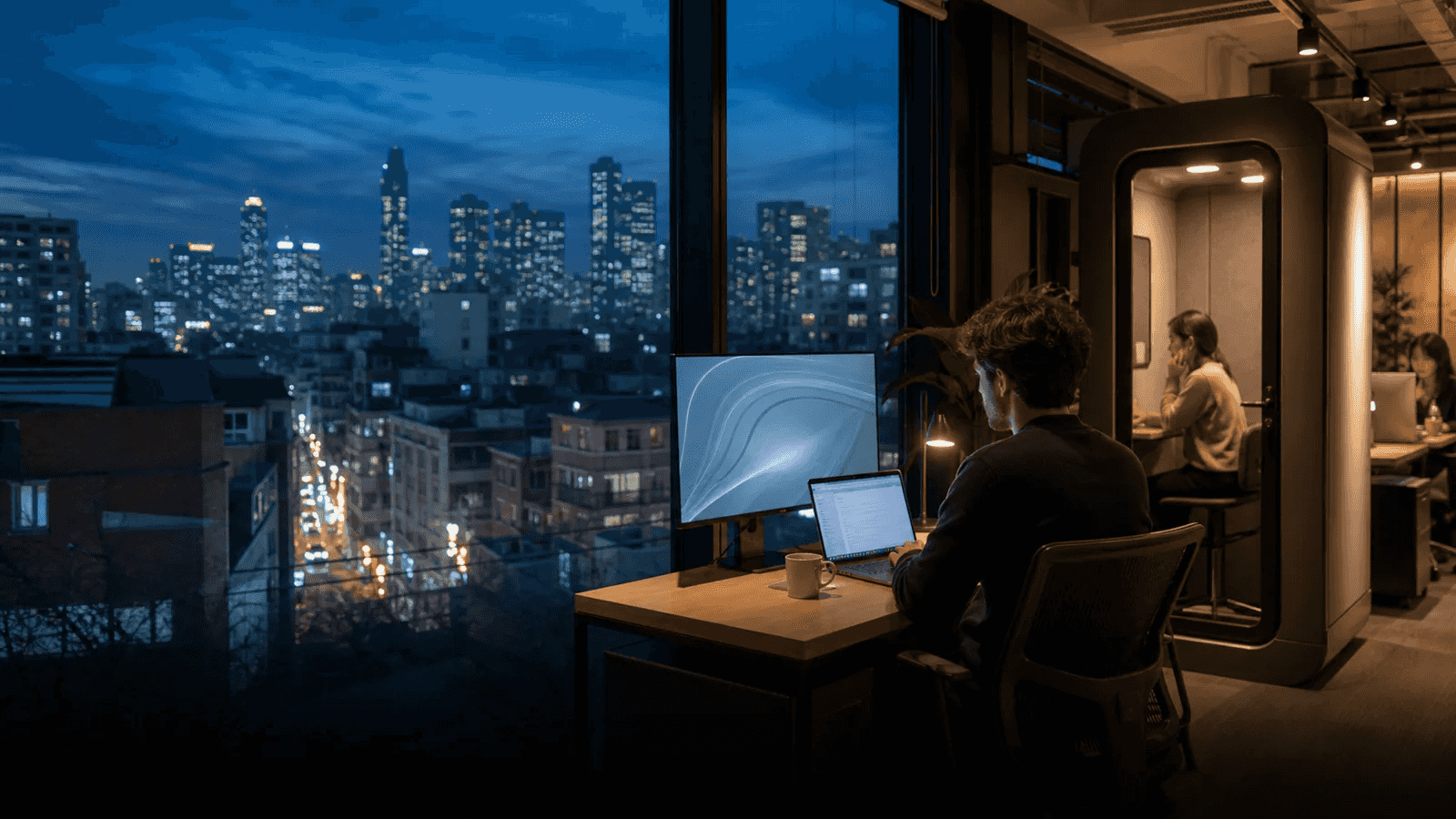
Seoul makes it easy to find Wi-Fi and surprisingly difficult to identify a desk where a foreign visitor can take three client calls, pay without a Korean subscription and still enter after dinner. Search results mix coworking offices, study cafes, meeting-room rentals and resident memberships as if they solve the same problem. They do not. The useful question is not ‘Where can I open a laptop?’ It is ‘Which access product supports my actual workday?’
We checked operator-published prices, hours and access rules on August 19, 2026. The shortlist favors spaces with a clear day pass or short monthly product and enough detail to plan a work session before crossing the city. Seoul’s operators can change branch rules, and some pages use machine translation, so confirm your date, payment method and call requirements directly before relying on a desk.
- Best international setup
- Behongli in Mapo for 24-hour member access, bookable short passes, monitors and a soundproof phone booth
- Best low-cost network
- SPARKPLUS Lounge Pass, with Metro one-day products from KRW 9,900 at selected branches
- Best community value
- Blue Pebbles for a KRW 18,000 day trial and KRW 200,000 flexible month
- Best quiet monthly base
- Commons Space in Mapo, with flexible monthly seating from KRW 150,000
- Best private day office
- Dreamcube in Sangam, with a vacancy-dependent private room day pass at KRW 33,000
- Research date
- Public products and access rules checked August 19, 2026
Seoul coworking comparison for digital nomads
- Behongli
- KRW 22,000 day pass; KRW 100,000 five-day flex pass; advance request expected
- SPARKPLUS
- Metro one-day from KRW 9,900; weekend one-day from KRW 20,000; branch and time rules vary
- Blue Pebbles
- KRW 18,000 day trial; KRW 80,000 five days; KRW 200,000 one month
- Commons Space
- KRW 15,000 day; KRW 150,000 flexible month; fixed seating from KRW 200,000
- Dreamcube
- KRW 11,000 open-desk day; KRW 33,000 private office day, subject to vacancy
The comparison is only a starting point. Behongli’s higher day price buys a visitor-oriented process and call infrastructure. SPARKPLUS can be much cheaper, but the Metro product limits you to a selected branch and day pattern. Blue Pebbles and Commons Space make more sense when you want the same neighborhood for weeks. Dreamcube solves a different problem: an inexpensive private room in Seoul’s digital-media district when availability permits.
1. Behongli: best for international nomads and late work
Behongli is in the Mapo and Hongdae orbit at 2F, 12 Seongmisan-ro 17-gil. Its English-language site explains the arrival process unusually well. A day pass is KRW 22,000 and runs from 06:00 to 05:59. The five-day flex pass is KRW 100,000 and can be used for five visits within 15 days. Registered members receive 24-hour access, but a one-day visitor should not assume instant entry at any hour.
The operator asks day visitors to submit a request at least 24 hours before arrival. For a last-minute request, it suggests WhatsApp and warns that walk-ins may not be accommodated. That is not friction to ignore; it is useful certainty. A confirmed access message is better than arriving at a keypad after an overnight flight with no local number.
- Work setup: 24 and 27-inch monitors with adapters, power and a soundproof phone booth.
- Shared facilities: meeting and community rooms, printing, scanning, fax, coffee, tea, heating, air conditioning and air purifiers.
- Flex-pass inclusions: one coffee and five prints per visit on the operator’s current page.
- Best for: North America-facing schedules, planned video calls and visitors who value English access instructions.
- Main limitation: prebooking matters, and late-night transport home still needs its own plan.
2. SPARKPLUS Lounge Pass: best low-cost station network
SPARKPLUS operates a broad Seoul network and sells lounge products separately from conventional private offices. Its current Metro one-day option starts at KRW 9,900. The public conditions describe one use per week, a choice of one among four Metro branches and open seating. A weekend one-day product starts at KRW 20,000 for one selected branch on one weekend day.
The price is compelling, but ‘SPARKPLUS access’ is not one universal product. Some locations and products support 24-hour use, while some lounge pages list 08:00 to 22:00. Amenities vary by branch: examples shown include monitor desks, bar tables, work sofas, focus rooms, booth tables and meeting rooms. Confirm the selected location, entry window and exact facility list before arranging calls around it.
- Best for: a low-cost focus day near a participating transit hub or workers moving between Seoul districts.
- Strongest advantage: network breadth and an unusually low published entry point.
- Main limitation: branch, weekly-use and operating-hour conditions are easy to miss in a headline price.
- Check before buying: foreign payment support, app or identity requirements, branch selection, re-entry, phone booth access and meeting-room credits.
3. Blue Pebbles: best community and flexible month
Blue Pebbles is a small-space alternative to a corporate network. Its current public plans list a KRW 18,000 day trial, KRW 80,000 five-day pass and KRW 200,000 one-month membership. Included features list gigabit internet, coffee and tea, meeting rooms, snacks and fruit, and black-and-white printing. Monthly members also receive event access, which gives the product more social value than a sequence of anonymous day desks.
The published weekday office hours are 11:00 to 21:00. The FAQ says monthly-member hours can be agreed, so do not translate that into automatic 24-hour access. Meeting rooms require booking, monitors and chargers can be rented, and different plans include different meeting-room allowances. Ask for the complete current inclusions before deciding whether the KRW 200,000 month replaces separate call-room spending.
- Best for: repeat workdays, a smaller community and a straightforward month-to-month base.
- Strongest advantage: competitive monthly price with events and basic workday amenities.
- Main limitation: public office hours are not suitable for every US-facing schedule.
- Check before buying: agreed member access hours, meeting-room allowance, monitor rental and current event calendar.
4. Commons Space: best quiet Mapo monthly value
Commons Space at 72 Poeun-ro in Mapo publishes both day and monthly prices. The day rate is KRW 15,000. A flexible monthly seat is KRW 150,000, a fixed window seat KRW 200,000 and a fixed desk KRW 250,000. A team office is shown at KRW 500,000. For a month-long Seoul stay, the flexible product reaches break-even against day passes after ten visits.
The current facility list includes 5G Wi-Fi, continuous heating and cooling, mobile-key access, a self-service bar, printing, lockers and a meeting room. Its rooftop and terrace are marked as preparing, so they should not influence a current purchase. This is a strong example of why a facility list must be read literally: planned amenities are not available amenities.
- Best for: focused repeat work in Mapo and workers who want an inexpensive monthly desk.
- Strongest advantage: transparent progression from day use to flex, fixed and team seating.
- Main limitation: verify English onboarding, call etiquette and meeting-room booking before purchase.
- Check before buying: visitor access hours, mobile-key setup for a foreign phone and whether calls are permitted at your chosen seat.
5. Dreamcube: best private day office in Sangam
Dreamcube occupies the 16th floor of the KGIT Center at 402 World Cup buk-ro in Sangam, Seoul’s digital-media district. Its live one-day page lists an open desk at KRW 11,000 including VAT and a private office at KRW 33,000, assigned according to vacancy. Coffee and tea are included. The application is followed by confirmation and payment instructions by text or email.
The private room can be excellent value for an interview, confidential workshop or concentrated deadline. It is less compelling if your accommodation and meetings are in Gangnam, because the cross-city commute becomes part of the price. The one-day page has been online for some time, so confirm current availability and procedure rather than assuming a form submission is a reservation.
Coworking, study cafe or ordinary cafe?
Seoul’s cafe culture is outstanding for reading, planning and light laptop work. A study cafe offers long hours, individual focus seating and low prices. Neither is automatically appropriate for client calls. Ordinary cafes can be noisy, seating can turn over, outlets are not guaranteed and a long video call may be inconsiderate. Study cafes are intentionally quiet, which makes conversation the problem rather than the solution.
- Ordinary cafe
- Best for email, writing and a short session; poor choice for confidential or repeated calls
- Study cafe
- Best for silent focus and long hours; voice calls may be restricted to designated zones
- Coworking lounge
- Best for a full workday when phone booths and business facilities are confirmed
- Meeting room
- Best for important calls, interviews and workshops; often priced separately or by credits
- Private day office
- Best for privacy and call volume; check vacancy and ventilation before booking
Use a cafe as a deliberate light-work day, not as a failed coworking purchase. If you have one critical call, book the correct environment for that hour and use a cheaper focus seat around it. The hybrid often costs less than choosing a premium desk every day while still protecting your professional reputation.
Choose the neighborhood around your schedule
Mapo, Hongdae and Yeonnam
This is the strongest cluster in our shortlist: Behongli, Commons Space and Blue Pebbles all serve different versions of a Mapo workday. The area offers cafes, restaurants, airport-rail access and a social scene without requiring daily travel to Gangnam. It is a practical base for creative work and for nomads whose contacts are on Seoul’s west or central side.
Gangnam and the south side
Gangnam has dense corporate inventory and major coworking networks, but a polished private office does not guarantee a simple day pass. Select a specific branch and public access product before booking accommodation. For work tied to technology, finance or south-side meetings, paying more to remove daily river crossings can be rational.
Sangam and Digital Media City
Sangam is useful for media-industry meetings and quiet project days. Dreamcube’s private day office is attractive when you need a closed room, but it is not a central default for every visitor. Choose it for a reason, then plan the journey from Airport Railroad, Gyeongui-Jungang Line or Line 6 connections.
Central Seoul
City Hall, Jongno, Euljiro and Seoul Station reduce travel time to many business districts. Network operators can be the easiest option here, but inspect each branch’s lounge product. A prestigious address is irrelevant if the desk pass excludes the phone booth or closes before your overseas team starts work.
The Seoul access-friction checklist
Korean consumer services are highly digital, but many assume a domestic phone number, local identity verification, Korean-language app flow or locally issued payment method. Independent coworking spaces can be easier because staff confirm access by email or WhatsApp. Network products may be cheaper but require more setup. Neither model is inherently better; the risk is discovering the requirement at the door.
- Can a visitor register with a passport and foreign phone number?
- Can I pay with an international Visa or Mastercard, and does online authentication work?
- Will the door code, mobile key or QR work without a Korean app-store account?
- Is re-entry allowed during a day pass, or does leaving end the session?
- Must I arrive during staffed hours for the first identity check?
- Can the operator send written access instructions in English before arrival?
- Does the receipt include a business name and amount if I need to expense the desk?
Phone booths and meeting rooms: ask the exact question
A listing that shows a phone booth does not prove it is included, reservable or available for an hour. Ask how many booths serve the floor, whether sessions are time-limited, whether a day pass can reserve one and whether other members treat them as private offices. For meeting rooms, ask the hourly rate, included credits, minimum booking, cancellation rule and guest policy.
For a decisive sales call or interview, reserve a room and save the confirmation. Arrive early enough to test camera angle, ventilation, sound leakage and upload stability. Acoustic booths can become hot during a long meeting. A beautiful shared floor cannot compensate for poor audio when your work depends on conversation.
A one-day Seoul coworking test
- Book through the real visitor process rather than asking for a special tour.
- Arrive at the time you expect to work and complete the door-access flow yourself.
- Run a speed and latency test on the normal member network, not a staff network.
- Connect your laptop, monitor, charger and VPN exactly as you would on a client day.
- Take one permitted call and listen for hallway, ventilation and neighboring-booth noise.
- Use the bathroom, water, print and food-break routine to expose small friction.
- Check the seat and screen after two hours, not two minutes.
- Leave after your likely finishing time and test the real journey home.
How much should a month of coworking cost?
Start with planned desk days. Commons Space’s KRW 150,000 flex month equals ten of its KRW 15,000 days. Blue Pebbles’ KRW 200,000 month equals roughly eleven of its KRW 18,000 day trials, although a trial is not always intended as an endlessly repeatable day product. Behongli’s five-day flex pass reduces its rate from KRW 22,000 to KRW 20,000 per visit and is useful for a shorter stay.
Then price calls. If a cheap monthly desk requires six paid meeting-room hours, include them. If a more expensive pass includes booths, monitors and late HVAC, credit only the features you will use. Also value cancellation risk: a day product protects a city-hopping schedule, while a month secures a routine. There is no discount when half the validity expires during a side trip to Busan.
Internet reliability beyond a speed-test screenshot
Seoul’s fast fixed networks create high expectations, but a workday can still fail because of crowded Wi-Fi, captive portals, VPN blocking or a weak booth signal. Test download, upload, latency and packet loss during the busy period. Ask whether Ethernet is available and whether the operator has a separate provider or mobile failover when the main line fails.
Carry a local mobile-data backup and a cable or adapter that works with your hardware. The backup should be tested before a deadline. Do not turn a private phone booth into a dead zone by discovering that its materials weaken both Wi-Fi and cellular signal. For critical calls, your fallback matters more than a spectacular off-peak download number.
A practical Seoul workweek
- Monday
- Coworking day with calls, printing and team coordination
- Tuesday
- Quiet home or study-cafe focus if the work is genuinely silent
- Wednesday
- Coworking plus a prebooked meeting room for the heaviest call block
- Thursday
- Cafe or library-style planning session, then local exploration
- Friday
- Coworking near evening plans to avoid a second cross-city commute
- Late shift
- Use a confirmed 24-hour member product and plan the trip home before starting
Our Seoul coworking verdict
Behongli is the safest first choice for an international visitor who needs clear onboarding, monitors, calls and late access. SPARKPLUS wins on entry price and network usefulness when its selected branch rules match your day. Blue Pebbles offers a friendly, feature-rich month; Commons Space is the sharpest transparent value for a repeat Mapo desk; Dreamcube is the specialist choice when a private day office in Sangam solves a real privacy need.
Book one representative day before committing. Use the access flow, make the call, finish at your normal hour and travel home. Seoul’s work infrastructure is excellent when product and schedule align. The mistake is buying a category called coworking when what you needed was a booth, a late key and a desk on the correct side of the city.
What is the best coworking space in Seoul for digital nomads?
Behongli is the strongest all-round choice for international onboarding, calls and late work. SPARKPLUS offers the lowest published network entry point, Blue Pebbles and Commons Space are strong monthly-value options in Mapo, and Dreamcube is useful for a private day office in Sangam.
How much is a coworking day pass in Seoul?
Current published examples range from KRW 9,900 for a selected SPARKPLUS Metro one-day product to KRW 22,000 at Behongli. Commons Space lists KRW 15,000, Blue Pebbles KRW 18,000 and Dreamcube KRW 11,000 for an open desk. Confirm eligibility and booking rules before arrival.
Are there 24-hour coworking spaces in Seoul?
Yes, but 24-hour access is product and branch specific. Behongli gives registered members 24-hour access, while SPARKPLUS hours vary and some lounge products operate 08:00 to 22:00. Verify first-entry requirements and plan late-night transport home.
Can foreigners book coworking in Seoul without a Korean phone number?
Some independent spaces support email or WhatsApp booking, but network products can rely on domestic apps, phone verification or local payment. Ask whether passport registration, a foreign number and an international card are accepted before paying.
Can I take video calls from a Seoul study cafe?
Usually not from the silent seating area. Study cafes are designed for quiet focus and may restrict calls to separate zones. Use a coworking phone booth, meeting room or private office for frequent, confidential or important calls.
Which Seoul neighborhood is best for coworking?
Mapo, Hongdae and Yeonnam provide the strongest short-pass cluster in this guide. Gangnam is better for south-side corporate meetings, central Seoul reduces cross-city travel, and Sangam suits digital-media work. Choose around accommodation and working hours, not neighborhood reputation alone.
Official Seoul coworking products
- Behongli passes and facilities
- SPARKPLUS Lounge Pass
- SPARKPLUS office and branch access
- Blue Pebbles plans and pricing
- Blue Pebbles access FAQ
- Commons Space Mapo
- Dreamcube one-day office
Build the rest of your Seoul setup