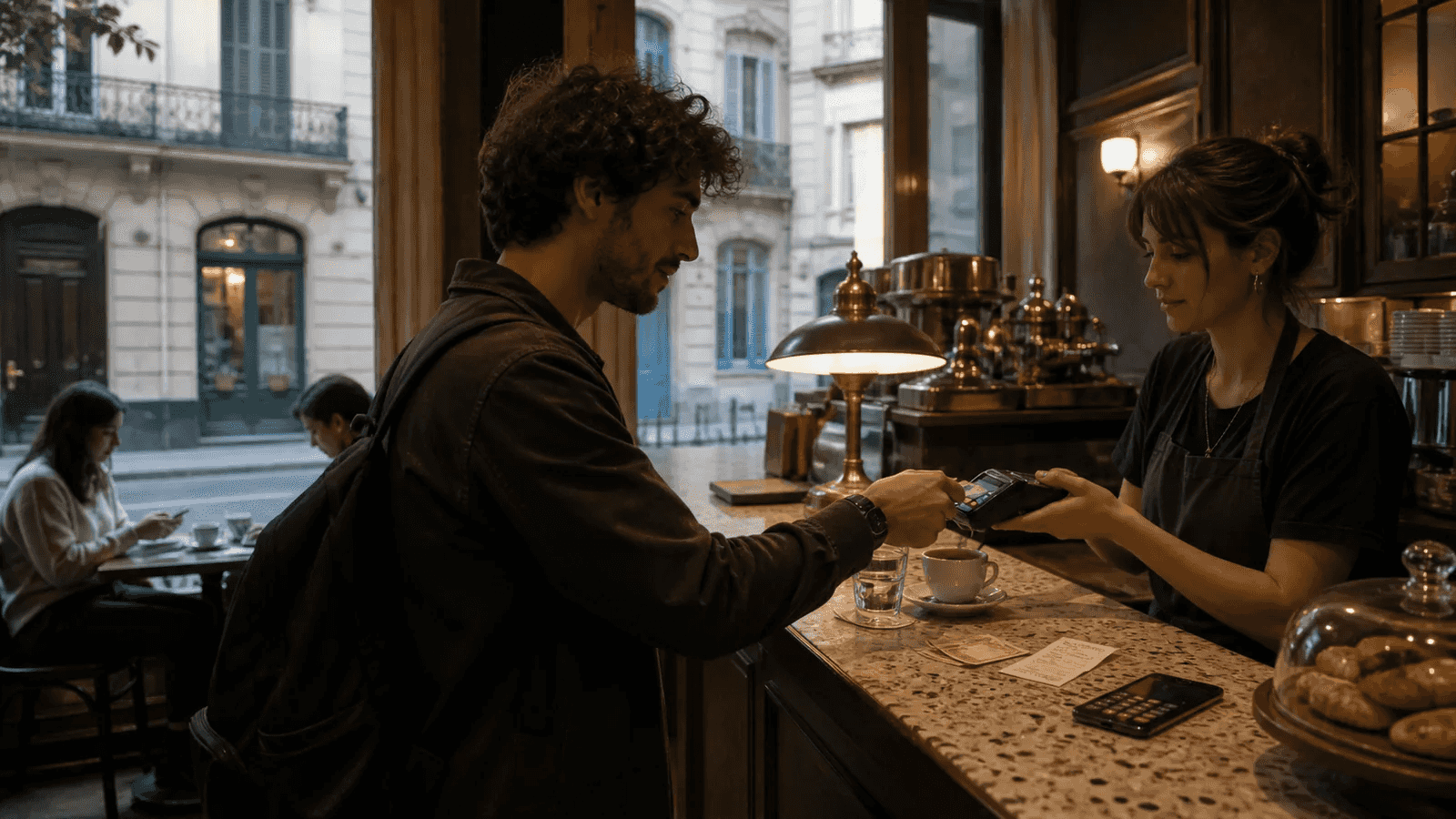
Most Buenos Aires money advice online was written for a different Argentine economy. It tells visitors to arrive with a thick envelope of US dollars, memorize the blue rate and distrust every card. That may describe an earlier trip, but it is not a safe operating system for 2026. Argentina changed its exchange framework in April 2025, foreign-card transactions have a formal tourist mechanism, and the final rate still depends on the network, issuer, posting date and fees.
The right answer is not ‘cash only’ or ‘card only.’ It is a small controlled test, two independent payment rails and a modest peso reserve. This guide uses Buenos Aires city guidance, Argentina’s central bank and current card-network rules checked on August 19, 2026. It deliberately avoids publishing one peso rate because a fixed number can become wrong before you land.
- Local currency
- Argentine peso, code ARS; a plain $ price usually means pesos, while US dollars may be marked U$S or USD
- Best default
- Pay a small purchase in ARS with a no-foreign-transaction-fee card, then calculate the final posted rate
- Cash role
- Carry a modest peso reserve for small merchants, tips, markets and a card-system interruption
- Exchange rule
- Use regulated banks or casas de cambio; avoid street changers and informal approaches on Calle Florida
- Terminal choice
- Choose Argentine pesos and decline conversion into your home currency unless you have compared the disclosed DCC cost
- Research date
- Mechanisms and official guidance checked August 19, 2026
The three rates a traveler needs to understand
The official reference
Argentina’s central bank, the BCRA, publishes wholesale and retail exchange references. Since April 2025, the official peso has operated inside an exchange-rate band. The BCRA says that from January 1, 2026 the band limits adjust according to inflation. This is the correct public reference for the formal market, but it is not automatically the exact rate your foreign bank uses on a purchase.
The MEP or financial-dollar reference
MEP is a financial-market exchange reference derived through securities transactions. Argentina introduced a mechanism so eligible purchases made by nonresidents with foreign-issued cards can receive a preferential tourist conversion linked to the financial-dollar market. Visa’s Argentine support page says its tourist rate is slightly below MEP while the system remains in force. That is a mechanism, not a guarantee of one public number across every issuer.
Your effective card rate
This is the rate that matters to your budget. Divide the ARS purchase amount by the final amount charged in your home currency, after foreign-transaction fees and after any later adjustment. Processing date can differ from purchase date. A Visa, Mastercard and different issuing banks can produce different timing and totals even at the same cafe.
Why advice from before April 2025 can be wrong
On April 11, 2025, the BCRA announced phase three of Argentina’s economic program. It eliminated exchange restrictions on individuals and introduced the band regime. That did not freeze inflation, remove every spread or make all payment methods equal. It did make many older explanations of a permanently locked official market obsolete.
Current planning should therefore begin with today’s BCRA references and your card’s tested settlement, not a blog screenshot from 2023. Informal and financial-market spreads can widen or narrow as policy and market conditions change. A clever workaround from a previous year can become a worse deal, an unnecessary risk or both.
The five-minute foreign-card test
- Choose a normal merchant and make a small purchase priced in Argentine pesos.
- Tell the terminal operator you want to pay in pesos if a currency choice appears.
- Save the receipt and note the exact ARS amount and purchase time.
- Wait for the transaction to move from pending to final on your account.
- Add any foreign-transaction or cross-border fee charged by your issuer.
- Divide the ARS amount by the final home-currency cost to find the effective rate.
- Compare it with the same day’s BCRA references and the legal cash option available to you.
- Repeat on your backup card before deciding which rail will handle large expenses.
For example, if an item costs 24,000 ARS and the final statement cost is 16 units of your home currency, your effective result is 1,500 ARS per home-currency unit. That is a method example, not a current Argentine rate. If the issuer later adds a fee, include it and recalculate. The process is deliberately boring, which is why it works.
When cards are the best tool
Buenos Aires tourism guidance says major businesses and hotels commonly accept cards, while smaller businesses may require cash. For supermarkets, established restaurants, pharmacies, accommodation and larger purchases, a tested foreign card can reduce the need to carry and exchange cash. Contactless acceptance is widespread enough to be useful, but no traveler should depend on one plastic card or one phone wallet.
- Use a card with no foreign-transaction fee as the primary rail.
- Carry a second card from a different network or issuer, stored separately.
- Enable transaction alerts and keep issuer support available without relying on the physical card.
- Check whether cash advances and ATM withdrawals trigger interest immediately on a credit card.
- Keep enough limit for a temporary duplicate authorization or accommodation hold.
- Retain receipts until transactions settle, especially for refunds and tips added after authorization.
Always recognize dynamic currency conversion
Dynamic currency conversion, or DCC, occurs when a merchant or ATM offers to convert an Argentine-peso transaction into your card’s home currency. Visa explains that the offer should disclose both amounts, the exchange rate and added markup or fees, and that the customer must be able to accept or decline. Mastercard likewise requires a genuine choice between local and billing currency with the conversion details shown.
The convenience of seeing euros, pounds or dollars on screen is not free. Visa’s general travel guidance says DCC often carries an inflated exchange-rate markup. The usual cost-controlled choice is ARS, allowing your card network and issuer to perform the conversion. If a terminal selects your home currency without permission, keep the receipt and contact your issuer.
Cash still has a job, but not the whole job
Keep pesos for small cafes, markets, tips, kiosks, occasional cash discounts and a payment-terminal outage. The objective is resilience, not a large speculative cash position. Exchange enough for the next few days, then replenish through a verified legal channel. This reduces loss risk and prevents you from spending half a workday optimizing a tiny spread.
Buenos Aires city guidance tells travelers to use regulated banks and casas de cambio and warns that street or off-market changers are illegal. Calle Florida approaches, often called arbolitos, expose you to counterfeit notes, theft, bait rates and no receipt. A favorable quoted number is not a favorable transaction if you cannot safely verify or document it.
- Exchange in a controlled indoor location and count notes before leaving the counter.
- Bring the identification the regulated institution requires and ask about fees before handing over currency.
- Keep the exchange receipt until the cash is spent.
- Separate daily cash from the reserve and avoid displaying a large bundle in public.
- Do not exchange for a stranger, carry money for someone else or follow a street promoter to another location.
The formal nonresident cash-exchange route
The BCRA created a formal mechanism allowing regulated financial entities to buy foreign currency from nonresident tourists at a financial-market reference, with a monthly equivalent limit of USD 5,000 in the original measure. Identification and a declaration of tourist status were required. That official route is preferable to an informal street transaction.
However, the enabling announcement dates from 2022 and participating branches and procedures can change. Verify with a regulated bank or casa de cambio before relying on the facility, especially if you plan to exchange a large amount. Bring a second payment option so a branch refusal or changed documentation rule does not become an emergency.
ATMs are a fallback, not a mystery fee
The city says ATMs accept major international cards, but that does not mean every withdrawal is economical. An ATM can combine a local operator fee, your bank’s withdrawal fee, a foreign-exchange fee and DCC. It can also impose a low per-transaction limit. Read the screen all the way to the final confirmation and cancel if the disclosed fixed fee makes the amount irrational.
- Use an ATM attached to a regulated bank during open hours when possible.
- Inspect the card slot and shield the keypad.
- Choose ARS and decline DCC into your billing currency.
- Read the local fee and withdrawal amount before confirming.
- Use a debit card designed for cash, not a credit card that may treat the transaction as a cash advance.
- Record the final home-currency debit and compare it with your card-purchase and legal-exchange results.
QR wallets are possible, not universal
Argentina’s central bank extended the foreign-tourist mechanism to eligible payments made through interoperable QR wallets when a local wallet provider has an agreement with the foreign wallet. That does not mean any overseas banking app can scan every Argentine QR code. Local identity, account and provider requirements can still make resident-oriented wallets inaccessible to a visitor.
Treat QR compatibility as a bonus you test, not a core arrival dependency. Ask your existing provider whether Argentine interoperable QR is supported, make a small transaction and inspect the final conversion. Do not transfer a large balance into a new service before understanding withdrawal, support and account-verification rules.
Paying for transport in Buenos Aires
The SUBE card remains a useful transit tool, especially when you want one stored-value rail across the network. Buenos Aires also says all subway stations have identified validators that accept enabled credit, debit and prepaid cards, NFC devices and QR. The city’s current bus data likewise tracks transactions made through physical or virtual bank cards alongside SUBE and QR.
A foreign contactless card may be convenient, but use the same card or device consistently when a fare system calculates benefits by payment credential. Keep SUBE as a fallback if you plan to use transport extensively or travel beyond the routes where bank-card acceptance is clear. Never let a failed phone battery become the only reason you cannot board.
Housing quoted in dollars needs a written payment rule
Furnished rentals aimed at foreigners are often discussed or quoted in US dollars even when everyday expenses are in pesos. Before reserving, ask which currency the contract legally states, which currency is accepted on each due date, how any conversion is calculated, who absorbs transfer fees and what receipt you receive. ‘USD 1,000 equivalent’ is incomplete without a named reference rate and time.
Do not carry a large cash housing payment to an unverified apartment. Confirm the owner or manager, contract and payment instructions through a separate channel. If the rent is paid in cash, sign a dated receipt with currency, amount, rental period, unit and recipient. If it is paid by card or transfer, include platform and bank fees in the real rent comparison.
A resilient nomad wallet for Buenos Aires
- Primary rail
- Foreign debit or credit card with no foreign-transaction fee, tested after final posting
- Second rail
- Different issuer or network, kept separately and enabled for international use
- Cash layer
- Several days of pesos, not the entire stay budget
- Exchange layer
- One identified regulated bank or casa de cambio with current requirements confirmed
- Transport layer
- Contactless card where accepted plus a working SUBE fallback
- Evidence layer
- Receipts, posted transaction screenshots and a simple rate log for larger spending
The weekly money routine
- Check current BCRA references once, not every hour.
- Review final posted card transactions and calculate the effective rate including fees.
- Estimate the next seven days of cash-only spending and replenish a modest amount legally.
- Pay larger predictable expenses through the tested rail with a receipt.
- Move excess cash and the backup card out of the daily wallet.
- Update a USD or EUR-based budget so nominal peso changes do not hide real overspending.
- Re-test after a policy announcement, issuer change or surprisingly different transaction.
This routine prevents two common errors: optimizing every coffee while ignoring a poor housing conversion, and assuming last month’s card result will continue forever. Focus precision on rent, coworking, travel and other large expenses. For small daily purchases, consistency and safety are often worth more than the final fraction of a percent.
Common Buenos Aires money mistakes
- Using a pre-2025 article as if Argentina’s exchange framework never changed.
- Comparing a pending card notification with a final cash rate.
- Accepting home-currency DCC because the terminal presents it more prominently.
- Carrying the whole month’s budget in cash to chase a spread.
- Using a street changer without legal protection, receipt or safe note verification.
- Depending on one card, one phone wallet or one ATM network.
- Agreeing to a dollar-linked rent without a written currency and conversion clause.
- Quoting today’s peso rate in a long-term budget as though it cannot move.
Our Buenos Aires money verdict
Arrive with two usable cards, a small amount of backup value and no commitment to one old rule of thumb. Make a small ARS card purchase, wait for the final posting and calculate the real rate. Use that tested card for suitable merchants, carry a modest peso reserve and exchange only through regulated channels. Choose pesos at the terminal and recognize DCC before approving it.
The advantage is not only financial. A mixed system reduces time spent sourcing cash, lowers theft exposure and keeps you functioning when a terminal, card or branch fails. Buenos Aires is easier when money becomes a weekly process instead of a daily speculation.
Should tourists use cash or card in Buenos Aires in 2026?
Use both. A tested foreign card is efficient at larger established merchants, while pesos remain useful for small businesses, tips, markets and outages. Keep a backup card and only a modest cash reserve.
Do foreign credit cards get the MEP rate in Argentina?
Eligible foreign-issued card purchases use a formal tourist mechanism linked to the financial-dollar market. Visa says its tourist rate is slightly below MEP while the system is in force. Your effective result still depends on network, issuer, posting date and fees, so verify a final transaction.
How do I check the exchange rate on my foreign card in Argentina?
Make a small purchase in ARS, wait until it posts, add every issuer fee and divide the ARS purchase amount by the final cost in your home currency. Compare that effective rate with current BCRA references.
Where should I exchange money in Buenos Aires?
Use a regulated bank or casa de cambio and confirm its current identification and transaction requirements. Buenos Aires city guidance warns against illegal off-market street changers, including approaches around Calle Florida.
Should I choose pesos or my home currency at an Argentine card terminal?
The usual cost-controlled choice is Argentine pesos, which avoids merchant or ATM dynamic currency conversion. DCC must disclose the conversion and fees, but it often includes a markup. Read the screen and decline home-currency conversion unless you have deliberately compared it.
Can I use a foreign contactless card on Buenos Aires public transport?
Buenos Aires says subway validators accept enabled credit, debit and prepaid cards, NFC devices and QR. Acceptance can still depend on the card and route, so keep a charged payment device and a SUBE fallback for broader transit use.
Official money and payment sources
- Buenos Aires official visitor money guidance
- BCRA current exchange-rate band regime
- BCRA retail exchange-rate comparison
- BCRA April 2025 economic program phase three
- BCRA foreign-card and QR tourist mechanism
- Visa Argentina foreign-tourist exchange explanation
- Visa dynamic currency conversion guide
- BCRA regulated nonresident tourist exchange mechanism
- Buenos Aires subway payment methods
Build the rest of your Buenos Aires setup